Today's
EarthStation1.com 15% (Or More!) Off Commemorative Memorial Title:
Escape! Radio Adventure Series MP3 Set DVD, Download, USB Drive
Today, August 29, 2026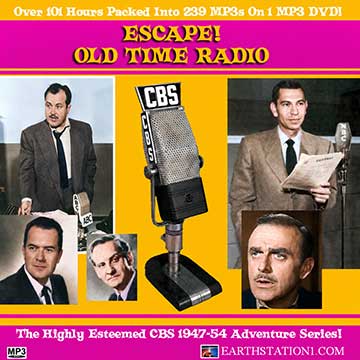
August 29: According To Hoyle Day: --
August 29, 1769: #DOTD: #RIP: Edmond Hoyle, English author and
educator, best known for his works on the rules and play of card
games (b. 1672, exact birth date unknown) #dies at age 97 on
Wellbank Street (today Welbeck Street), Cavendish Square, London,
England. He is buried at St. Marylebone Churchyard in Marylebone,
City of Westminster, Greater London, England. Little is known
about Hoyle's early life prior to publication of his books, other
than that he was born in England. Much of what is written about
him is untrue or exaggerated. He was reputed to a lawyer by
profession, but the suggestion that he trained at the bar is not
known to be true. He is best-known for codifying the rules for
many board games - such as backgammon and chess, and card games.
The phrase "according to Hoyle" (meaning "strictly
according to the rules") came into the language as a
reflection of his generally perceived authority on the subject;
since that time, use of the phrase has expanded into general use
in situations in which a speaker wishes to indicate an appeal to a
putative authority. Arguably his most important contribution was a
small booklet he wrote in 1742 for the card game Whist, titled "A
Short Treatise on the Game of Whist." From then onwards, the
rules detailed in this booklet became authoritative for the game
for the next hundred years. Whenever players would refer to the
rules of games for which Hoyle had established them, they would
begin with the phrase "According to Hoyle_," indicating
that the rule is set in stone by the expert himself. With time,
this phrase became a way of assuring others that they are quoting
an expert, so whether people were debating a new law, discussing
history, theories, or rules of a card game, "According to
Hoyle" became a go-to saying. Hoyle's massive contributions
to creating the laws of many games, as well as honoring experts
and their authority on their respective areas of expertise, is
celebrated on According to Hoyle day. On Sale Until Midnight
Tonight PT!
https://store.earthstation1.com/escape-mp3-dvd-complete-radio-adventure-series-broadcast3.html
Today's
EarthStation1.com 15% (Or More!) Off Commemorative Memorial Title:
The Story Of Civilization: Will & Ariel Durant DVD, MP3
Download, USB
Today, August 29, 2026
August 29: Individual Rights Day: -- An
annual observance in honor of John Locke's birthday and
philosophical teachings. While the topic is subjective and has
been discussed for decades, John Locke (August 29, 1632 - October
28, 1704) was the first to firmly argue that all human beings have
sovereign identities and that it is the government's
responsibility to recognize these rights and safeguard them. John
Locke was an English philosopher, popularly known as the "Father
of Liberalism." He was among the most influential thinkers of
his time, and strongly advocated individual liberty and rights.
According to Locke, "Anything that a man has as a matter of
human rights or civil rights is to remain inviolably his."
Even though humans have to live in a system where some of their
natural rights are surrendered in return for the collectivity of
society and protection, Locke still listed complete liberty on how
to live one's life, freedom of speech, and freedom to stand
against the government as individual rights. The founder of the
Objectivist Party, Dr. Tom Stevens, is a staunch supporter of John
Locke's philosophies, especially those regarding the very
foundation of society - the individual. Dr. Tom Stevens, the
founder of the Objectivist Party, supports John Locke's
philosophies regarding the rights of society's smallest minority
and basic unit - the individual. The exact date of the inception
of the holiday is unknown, but Dr. Stevens is credited for
creating the annual celebration. On Sale Until Midnight Tonight
PT!
https://store.earthstation1.com/story-of-civilization-will-amp-ariel-durant-mp3-dvd-11-audiobo311.html
Today's
EarthStation1.com 15% (Or More!) Off Commemorative Memorial Title:
Czechoslovakia: The Long Wait For Revolution DVD, Download, USB
Drive
Today, August 29, 2026
August 29: National Uprising Day
(Anniversary Of The Slovak National Uprising) (Slovakia): --
Commemorates the August 29, 1944 Slovak National Uprising, when
60,000 Slovak troops turn against the Nazis during World War II.
It is also a day to honor the people of both Slovakia and Czech,
the former Czechoslovakia, who participated in the resistance
movement against Nazi rule. The genesis of the Slovak National
Uprising can be traced to September 1938 when the Munich Agreement
was signed. This agreement, which was signed by the European
powers, effectively ceded Sudetenland - a territory of
Czechoslovakia - to Nazi Germany. Czechoslovakia agreed to this as
a result of German military attacks and diplomatic pressure from
the United Kingdom, France, and Italy. Sudetenland, otherwise
known as the Sudeten German territory, was included within the
defined borders of Czechoslovakia when the country was newly
formed in 1918. However, this was done without the consent of the
Sudeten-based Germans, who were later accorded less consideration
than the Czechs and Slovaks. By 1936, 60% of the unemployed people
in Czechoslovakia were Germans. This was Germany's apparent reason
for claiming Sudetenland. In June 1944, aided by Slovakia's
pro-Nazi president, Jozef Tiso, German military forces began
occupying Czechoslovakia. A resistance movement was formed by
Czechoslovakia's exiled government, deserters from the Slovak
army, and other Slovak partisans. This uprising lasted for about
two months until it was partially suppressed by Germany in October
1944. In Slovakia, the uprising anniversary is not widely
celebrated, as some view the uprising as a pro-communist movement.
Catholic nationalists often condemn the uprising as a result of
the fact that Jozef Tiso - who was president at the time - was
also Catholic. However, in Bratislava, the country's capital, some
mark the occasion by placing wreaths on a memorial dedicated to
the uprising. On Sale Until Midnight Tonight PT!
https://store.earthstation1.com/czechoslovakia-the-long-wait-for-spring-dvd-1988-cold1988.html
Today's
EarthStation1.com 15% (Or More!) Off Commemorative Memorial Title:
Nuclear War Test Films Video Super Mega Set DVD, Download, USB
Drive
Today, August 29, 2026
August 29: International Day Against
Nuclear Tests: -- Established by the United Nations General
Assembly at their 64th session on December 2, 2009. Nearly 2,000
nuclear weapons tests have taken place since the first one on July
16, 1945. The side effects and dangers of nuclear energy testing
to human life were dismissed in the early days, but the magnitude
of its destructive nature has been proven time and time again in
history. Nuclear weapons are volatile and the world can do without
it. At the 64th session of the United Nations General Assembly on
December 2, 2009, the unanimous adoption of resolution 64/35
declared August 29 as the International Day Against Nuclear Tests.
The crux of the resolution was that "every effort should be
made to end nuclear tests in order to avert devastating and
harmful effects on the lives and health of people" and that
"the end of nuclear tests is one of the key means of
achieving the goal of a nuclear-weapon-free world." The
initiation for this day was by the Republic of Kazakhstan,
selecting August 29 as the date of the observance to align with
the shut down of the Semipalatinsk Nuclear Test site on the same
date in 1991. The inaugural observance of the International Day
Against Nuclear Tests was in 2010. Every year, massive efforts go
into arranging activities across the world; including conferences,
symposia, competitions, publications, media broadcasts, lectures,
and more. Many sponsors, government-level agencies, and civil
society organizations have aided the cause and campaigned for the
complete ban on nuclear testing. On Sale Until Midnight Tonight
PT!
https://store.earthstation1.com/21-disc-nuclear-war-test-films-dvd-set-collecti21.html
Today's
EarthStation1.com 15% (Or More!) Off Commemorative Memorial Title:
Heaven Man Earth: Kowloon Walled City The Hong Kong Triads DVD MP4
USB
Today, August 29, 2026
August 29, 1842: The Century Of
Humiliation (The Hundred Years Of National Humiliation)
(1838-1945): The Opium Wars: The First Opium War (The Opium War,
The Anglo-Chinese War): The Treaty Of Nanking: -- The Qing Dynasty
is forced to sign The Treaty of Nanking, the first of what the
Chinese later called the unequal treaties, which granted an
indemnity and extraterritoriality to Britain, opened five treaty
ports to foreign merchants, ceded Hong Kong Island to the British
Empire, and brought an end to The First Opium War. The failure of
the treaty to satisfy British goals of improved trade and
diplomatic relations led to the Second Opium War (1856-60), and
the Qing defeat resulted in social unrest within China. In China,
the war is considered the beginning of modern Chinese history. The
First Opium War began on November 3, 1839 when British frigates
blew up several Chinese junks. The war was a series of military
engagements fought between the United Kingdom and the Qing dynasty
over conflicting viewpoints on diplomatic relations, trade, and
the administration of justice in China. In the 17th and 18th
centuries demand for Chinese goods (particularly silk, porcelain,
and especially tea) in Europe created a trade imbalance between
Qing Imperial China and Great Britain. European silver flowed into
China through the Canton System, which confined incoming foreign
trade to the southern port city of Canton. To counter this
imbalance, the British East India Company began to auction opium
grown in India to independent foreign traders in exchange for
silver, and in doing so strengthened its trading influence in
Asia. The opium was transported to the Chinese coast where local
middlemen made massive profits selling the drug inside China. The
influx of narcotics reversed the Chinese trade surplus, drained
the economy of silver, and increased the numbers of opium addicts
inside the country. In 1839 the Daoguang Emperor, rejecting
proposals to legalise and tax opium, appointed viceroy Lin Zexu to
solve the problem by banning the opium trade. Lin confiscated
around 20,000 chests of opium (approximately 1210 tons or 2.66
million pounds) without offering compensation and ordered a
blockade of foreign trade in Canton. The British government,
although not officially denying China's right to control imports
of the drug, objected to this unexpected seizure and dispatched a
military force to China. In the ensuing conflict the Royal Navy
used its naval and gunnery power to inflict a series of decisive
defeats on the Chinese Empire,a tactic later referred to as
gunboat diplomacy. On Sale Until Midnight Tonight PT!
https://store.earthstation1.com/heaven-man-earth-the-organized-crime-of-the-chinese-triads-dvd.html
Today's
EarthStation1.com 15% (Or More!) Off Commemorative Memorial Title:
Know Your Enemy: Japan WWII Frank Capra + The Samurai MP4 Download
DVD
Today, August 29, 2026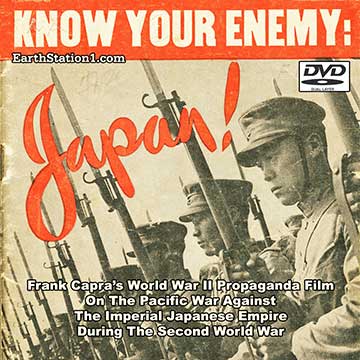
August 29, 1910: Korea: The History Of
Korea: The Korean Empire (The Empire Of Korea, Imperial Korea):
Korea Under Japanese Rule (Chosen [Korean: Joseon]): The
Japan-Korea Treaty Of 1910 (The Japan-Korea Annexation Treaty): --
Seven days after it was signed on a day commemorated by Korea as
National Humiliation Day, and fifteen years after the October 8,
1895 Eulmi Incident, when Queen Min of Joseon, the last empress of
Korea, was assassinated and her corpse burnt by Japanese
infiltrators inside Gyeongbok Palace in retaliation for her
resistance to Japanese expansion, The Japan-Korea Treaty Of 1910
goes into effect, whereby Korea is annexed by Japan with the
signing of the Japan-Korea Annexation Treaty. Officially known as
the The Japan-Korea Treaty of 1910, it began a period of Japanese
rule of Korea that lasted until the end of World War II. It was
made by representatives of the Empire Of Japan and the Korean
Empire, wherein Japan formally annexed Korea following the
Japan-Korea Treaty of 1905, by which Korea became a protectorate
of Japan, and Japan-Korea Treaty of 1907, by which Korea was
deprived of the administration of internal affairs. The treaty
went into effect on August 29, 1910, and was publicly proclaimed
to the public on that date, marking the official start of Japanese
Rule In Korea. The treaty had eight articles, the first being:
"His Majesty the Emperor of Korea makes the complete and
permanent cession to His Majesty the Emperor of Japan of all
rights of sovereignty over the whole of Korea". Gojong, the
last king of Joseon (the Korean dynastic kingdom of last five
centuries as a kingdom) and, as Emperor Gwangmu, the first Emperor
of Korea, later called the treaty a "neugyak" ("costly
medicine"). The alternative term used in lieu of joyak
("counterpart treaty") implies the treaty was coerced to
Koreans by Japanese. Gyeongsul Gukchi (National Humiliation Of The
Year Of Gyeongsul)" and Gukchi-il (National Humiliation Day)"
are alternative terms for the year and date the treaty was signed,
respectively. Japanese commentators of the time greatly
mispredicted that Koreans would easily assimilate into the
Japanese Empire; in fact, it bred profound anti-Japanese sentiment
throughout Korea, and its repercussions would ultimately result in
the evolution of competing forms of Korean nationlism responsible
for the outbreak of the Korean War of 1950-1953, and of the Korean
Conflict, a state of cold war which continues to this day, over a
century later. The United Kingdom had already acquiesced to the
annexation of Korea by Japan, via the British connection to
Imperial Japan via the Anglo-Japanese Alliance of 1902; and the
United States had also sanctioned the annexation, as per the
Taft-Katsura Agreement. The legality of the treaty was later
disputed by the exiled Provisional Government of the Republic of
Korea, as well as the South Korean government. While the treaty
was affixed with the national seal of the Korean Empire, Emperor
Sunjong of Korea refused to sign the treaty as required under
Korean law. The treaty was instead signed by Prime Minister Ye
Wanyong of the Korean Empire, and Resident General Count Terauchi
Masatake of the Empire Of Japan. This issue caused considerable
difficulty in negotiating the establishment of basic diplomatic
relations between the countries. Korea insisted on including a
chapter stipulating, "The treaty was null and void",
although Japanese government did not confirm the illegality.
Japanese government insisted the treaty was null and void in 1965.
A compromise was reached in language of Article II of the 1965
Treaty on Basic Relations: "It is confirmed that all treaties
or agreements concluded between the Empire Of Japan and the Empire
of Korea on or before August 22, 1910, are already null and void."
On Sale Until Midnight Tonight PT!
https://store.earthstation1.com/know-your-enemy-japan-1945-frank-capra-wwii-film-dvd-mp19454.html
Today's
EarthStation1.com 15% (Or More!) Off Commemorative Memorial Title:
The History Of Jazz A Video Retrospective DVD, MP4 Download, USB
Drive
Today, August 29, 2026
August 29, 1920: #BOTD: #HBD! Charlie
Parker, nicknamed Yardbird and Bird, highly influential African
American saxophonist virtuoso, composer and jazz soloist, pioneer
and leading figure of bebop, a form of jazz characterized by fast
tempos, virtuosic technique and advanced harmonies, one of the
greatest musicians of the twentieth century (d. March 12, 1955) is
#born Charles Parker Jr. at 852 Freeman Avenue in Kansas City,
Kansas, and raised in Kansas City, Missouri, near Westport and
later, in high school, near 15th and Olive St., to Charles Parker
Sr. and Adelaide "Addie" Bailey, who was of mixed
Choctaw and African American background. Charlie Parker was a
blazingly fast virtuoso, and he introduced revolutionary harmonic
ideas including rapid passing chords, new variants of altered
chords, and chord substitutions. His tone ranged from clean and
penetrating to sweet and somber. Parker acquired the nickname
"Yardbird" early in his career. This, and the shortened
form "Bird", continued to be used for the rest of his
life, inspiring the titles of a number of Parker compositions,
such as "Yardbird Suite", "Ornithology", "Bird
Gets the Worm", and "Bird of Paradise". Parker was
an icon for the hipster subculture and later the Beat Generation,
personifying the jazz musician as an uncompromising artist and
intellectual rather than just an entertainer. Charlie Parker died
in the suite of his friend and patron Baroness Pannonica de
Koenigswarter at the Stanhope Hotel in New York City, while
watching The Dorsey Brothers' Stage Show on television. The
official causes of death were lobar pneumonia and a bleeding
ulcer, but Parker also had an advanced case of cirrhosis and had
suffered a heart attack. The coroner who performed his autopsy
mistakenly estimated Parker's 34-year-old body to be between 50
and 60 years of age. He is buried at Lincoln Cemetery in Kansas
City, Missouri. On Sale Until Midnight Tonight PT!
https://store.earthstation1.com/the-history-of-jazz-by-billy-taylor-parts-i-amp-ii-dvd.html
Today's
EarthStation1.com 15% (Or More!) Off Commemorative Memorial Title:
The Beatles Last Paid Concert Live At Candlestick Park Download
MP3 CD
Today, August 29, 2026
August 29, 1966: Aesthetics: Performing
Arts: Finales: Musical Finales: American Musical Finales: Grand
Finales: The Beatles' 1966 US Tour: The Beatles' Final Concert
(The Beatles' 1966 Candlestick Park Concert): -- The Beatles
perform their last concert before paying fans when they appear at
Candlestick Park in San Francisco, California. Songs performed at
the show were "Rock and Roll Music", "She's a
Woman", "If I Needed Someone", "Day Tripper",
"Baby's in Black", "I Feel Fine", "Yesterday",
"I Wanna Be Your Man", "Nowhere Man",
"Paperback Writer", and "Long Tall Sally". A
rough recording of most of the concert was left unreleased,
although the audio has leaked on to the internet. The recording
cuts off during the last minute of the concert, interrupting "Long
Tall Sally". The Beatles had not announced that this was to
be their last concert, and if the foursome themselves knew, it was
a closely guarded secret. In fact, much of the existing film
footage of the concert was captured in color by a 15-year-old
Beatles fan, Barry Hood. A relatively small amount of
black-and-white footage was shot by local TV news in the San
Francisco Bay Area and Sacramento. Hood released some of his film
in a limited edition documentary titled The Beatles Live In San
Francisco. But more of Hood's rare footage remains in a vault,
unseen by the public as of 2017. On August 14, 2014, former Beatle
Paul McCartney returned one last time to become the closing act of
Candlestick Park's long history. McCartney's performance was
within days of being 48 years after the Beatles played their
famous last concert at Candlestick. To showcase the event,
McCartney contacted Barry Hood and used a portion of his original
1966 Beatles film on a big screen at this last concert. On Sale
Until Midnight Tonight PT!
https://store.earthstation1.com/the-beatles-last-paid-concert-live-at-candlestick-park-download-mp3-cd.html
Today's
EarthStation1.com 15% (Or More!) Off Commemorative Memorial Title:
TV Music & Dance Shows #8 American Action DVD, MP4, USB Flash
Drive
Today, August 29, 2026
August 29, 1958: #BOTD: #HBD! Michael
Jackson, dubbed "The King Of Pop", African American
singer-songwriter, producer, dancer,actor, and cultural icon, one
of the most popular entertainers in the world, and was the
best-selling music artist during the year of his death (d. June
25, 2009) is #born Michael Joseph Jackson in Gary, Indiana, the
eighth of ten children in the Jackson family, a working-class
African American family living in a two-bedroom house on Jackson
Street. Jackson's contributions to music, dance, and fashion along
with his publicized personal life made him a global figure in
popular culture for over four decades. The eighth child of the
Jackson family, Michael made his professional debut in 1964 with
his elder brothers Jackie, Tito, Jermaine, and Marlon as a member
of the Jackson 5. He began his solo career in 1971 while at Motown
Records. In the early 1980s, Jackson became a dominant figure in
popular music. His music videos, including those of "Beat
It", "Billie Jean", and "Thriller" from
his 1982 album Thriller, are credited with breaking racial
barriers and transforming the medium into an art form and
promotional tool. The popularity of these videos helped bring the
television channel MTV to fame. Jackson's 1987 album Bad spawned
the U.S. Billboard Hot 100 number-one singles "I Just Can't
Stop Loving You", "Bad", "The Way You Make Me
Feel", "Man in the Mirror", and "Dirty Diana",
becoming the first album to have five number-one singles in the
nation. He continued to innovate with videos such as "Black
or White" and "Scream" throughout the 1990s, and
forged a reputation as a touring solo artist. Through stage and
video performances, Jackson popularized a number of complicated
dance techniques, such as the robot and the moonwalk, to which he
gave the name. His distinctive sound and style has influenced
numerous artists of various music genres. Thriller is the
best-selling album of all time, with estimated sales of over 66
million copies worldwide. Jackson's other albums, including Off
the Wall (1979), Bad (1987), Dangerous (1991), and HIStory (1995),
also rank among the world's best-selling albums. He is one of the
few artists to have been inducted into the Rock and Roll Hall of
Fame twice, and was also inducted into the Songwriters Hall of
Fame and the Dance Hall of Fame as the only dancer from pop and
rock music. His other achievements include multiple Guinness World
Records including the Most Successful Entertainer of All Time,13
Grammy Awards, the Grammy Legend Award, the Grammy Lifetime
Achievement Award, 24 American Music Awards-more than any other
artist-including the "Artist of the Century", 13
number-one singles in the United States during his solo
career-more than any other male artist in the Hot 100 era-and
estimated sales of over 350 million records worldwide. Jackson won
hundreds of awards, making him the most awarded recording artist
in the history of popular music. He became the first artist in
history to have a top ten single in the Billboard Hot 100 in five
different decades when "Love Never Felt So Good" reached
number nine in 2014. Jackson is also remembered for his
philanthropy and pioneering efforts in charitable fundraising in
the entertainment industry. He traveled the world attending events
honoring his humanitarianism, and, in 2000, the Guinness World
Records recognized him for supporting 39 charities, more than any
other entertainer. Jackson became a figure of controversy in the
1980s due to his changing physical appearance, his relationships,
and behavior; the controversy intensified due to a 1993 child
sexual abuse scandal when a family friend accused him of sexually
abusing his son; the case led to an investigation but was settled
out of court for an undisclosed amount. In 2005, he was tried and
acquitted of further child sexual abuse allegations and several
other charges after the jury found him not guilty on all counts.
While preparing for his comeback concert series, This Is It,
Jackson died of acute propofol and benzodiazepine intoxication on
June 25, 2009, after suffering from cardiac arrest. The Los
Angeles County Coroner ruled his death a homicide, and his
personal physician, Conrad Murray, was convicted of involuntary
manslaughter. Jackson's death triggered a global outpouring of
grief, and a live broadcast of his public memorial service was
viewed around the world. Forbes ranked Jackson as the top-earning
deceased celebrity for the fifth consecutive year in 2017. His
estate earned 825M USD in 2016, the highest yearly amount ever
recorded by the publication. Michael Jackson died while preparing
for his comeback concert series, This Is It, of acute propofol and
benzodiazepine intoxication after suffering from cardiac arrest.
The Los Angeles County Coroner ruled his death a homicide, and his
personal physician, Conrad Murray, was convicted of involuntary
manslaughter. He is buried at Forest Lawn Memorial Park in
Glendale, Los Angeles County, California in the Great Mausoleum
Plot on Holly Terrace, Sanctuary of Ascension, Distinguished
Memorial, Sarcophagus 9, Crypt A. This mausoleum is private and
locked to the general public. Michael Joseph Jackson, dubbed the
"King of Pop", was one of the most popular entertainers
in the world, and was the best-selling music artist during the
year of his death. Jackson's death triggered a global outpouring
of grief, and a live broadcast of his public memorial service was
viewed around the world. Forbes ranked Jackson as the top-earning
deceased celebrity for the fifth consecutive year in 2017. His
estate earned 825M USD in 2016, the highest yearly amount ever
recorded by the publication. On Sale Until Midnight Tonight PT!
https://store.earthstation1.com/classic-tv-music-amp-dance-shows-8-where-american-action-is-dv8.html
Today's
EarthStation1.com 15% (Or More!) Off Commemorative Memorial Title:
Black Civil Rights Films: African-American History DVD, MP4, USB
Stick
Today, August 29, 2026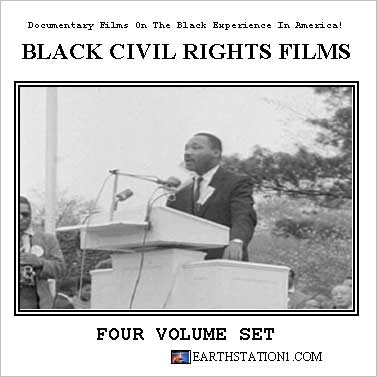
August 28, 1957: Civil Rights Movements:
The American Civil Rights Movement (1954-1968): Black Suffrage
(Black Political Franchise, Black Franchise, Black Right To Vote,
Black Active Suffrage): Anti-Discrimination Law In The United
States: The Civil Rights Act Of 1957: -- One day after U.S.
Senator Strom Thurmond's filibuster to prevent the Senate from
voting on the act, he stopped speaking 24 hours and 18 minutes
later, the longest filibuster ever conducted by a single Senator
up to that point, the senate then voted to pass the bill, and it
was sent to the White House, where President Eisenhower signed it
into law on September 9, 1957. The Supreme Court's 1954 ruling in
the case of Brown v. Board of Education brought the issue of
school desegregation to the fore of public attention, as Southern
leaders began a campaign of "massive resistance" against
desegregation. In the midst of this campaign, President Eisenhower
proposed a civil rights bill designed to provide federal
protection for African American voting rights; most African
Americans in the Southern United States had been effectively
disenfranchised by various state and local laws. This resulted in
the Civil Rights Act Of 1957, the first federal civil rights
legislation passed by the United States Congress since the Civil
Rights Act Of 1875, passed by the 85th United States Congress and
signed into law by President Dwight D. Eisenhower on September 9,
1957. Though the civil rights bill passed Congress, opponents of
the act were able to remove several provisions, limiting its
immediate impact. Despite these limitations in protection of
African American voter participation, the Civil Rights Act Of 1957
did establish the United States Commission on Civil Rights and the
United States Department Of Justice Civil Rights Division.
Congress would later pass far more effective civil rights laws in
the form of the Civil Rights Act Of 1964 and the Voting Rights Act
Of 1965. On Sale Until Midnight Tonight PT!
https://store.earthstation1.com/black-civil-rights-films-africanamerican-history-dvd.html
Today's
EarthStation1.com 15% (Or More!) Off Commemorative Memorial Title:
The Red Bomb Soviet Nuclear Bombs History + 2 Bonuses MP4 Download
DVD
Today, August 29, 2026
August 29, 1949: The Aftermath Of World
War II: The Cold War: The Cold War (1953-1962): Nuclear Warfare:
Nuclear Weapons Testing: Soviet Nuclear Warfare: Soviet Nuclear
Weapons Testing: The Soviet Atomic Bomb Project: The RDS-4 (From
The Soviet Codename For Their Atomic Bombs Reaktivnyy Dvigatel'
Spetsia, "Special Jet Engine"; Russian Codename:
Tatyana): -- The Soviet Union tests its first atomic bomb, the
RDS-1 or First Lightning, at 7 AM at the Semipalatinsk Test Site
in Semipalatinsk, Kazakhstan. It was code-named Joe-1 by the US,
after Joseph Stalin. The weapon was designed at the Kurchatov
Institute - at the time officially known as "Laboratory No.
2", but designated as the "office" or "base"
in internal documents - starting in April 1946. Plutonium for the
bomb was produced at the industrial complex Chelyabinsk-40. The
RDS-1 explosion yielded 22 kilotons of TNT, similar to the
American Gadget and Fat Man bombs. At Lavrentiy Beria's
insistence, the RDS-1 bomb was designed as an implosion weapon
similar to the Fat Man bomb dropped on Nagasaki, Japan; RDS-1 also
had a solid plutonium core. The bomb designers had developed a
more sophisticated design (tested later as RDS-2), but rejected it
due to the known reliability of the Fat Man type design, the USSR
having received extensive intelligence on the design of the Fat
Man bomb during World War II. In order to test the effects of the
new weapon, workers constructed houses made of wood and bricks,
along with a bridge, and a simulated metro in the vicinity of the
test site. Armoured hardware and approximately 50 aircraft were
also brought to the testing grounds, as well as over 1,500 animals
to test the bomb's effects on life. The resulting data showed the
RDS explosion to be 50% more destructive than originally estimated
by its engineers. There are several explanations for the USSR
code-name of RDS-1, usually an arbitrary designation: a backronym
"Special Jet Engine", or "Stalin's Jet Engine",
or "Russia does it herself" (a backronym, or bacronym,
is a constructed phrase that purports to be the source of a word
that is an acronym, i.e. when NASA named its ISS treadmill the
Combined Operational Load-Bearing External Resistance Treadmill
(C.O.L.B.E.R.T.) after Stephen Colbert). Later weapons were also
designated RDS, but with different model numbers. Mikhail
Pervukhin served as the chairman of the commission in charge of
the RDS-1 testing. Five RDS-1 weapons were completed as a pilot
series by March 1950 with a serial production of the weapon that
began in December 1951. Some United States Air Force WB-29 weather
reconnaissance aircraft were fitted with special filters to
collect atmospheric radioactive debris. On 1 September 1949, the
Air Force Office of Atomic Energy had a WB-29 fly from Misawa Air
Base in Japan to Eielson Air Force Base in Alaska. The plane
collected some debris during this flight. These data were then
cross-checked with data from later flights, and it was determined
that the Soviet Union had effectively tested a nuclear weapon. The
test surprised the Western powers. American intelligence had
estimated that the Soviets would not produce an atomic weapon
until 1953, while the British did not expect it until 1954. When
the nuclear fission products from the test were detected by the
U.S. Air Force, the United States began to follow the trail of the
nuclear fallout debris. President Harry S. Truman notified the
world of the situation on 23 September 1949: "We have
evidence that within recent weeks an atomic explosion occurred in
the U.S.S.R." Truman's statement likely in turn surprised the
Soviets, who had hoped to keep the test a secret to avoid
encouraging the Americans to increase their atomic programs, and
did not know that the United States had built a test-detection
system using the WB-29 Superfortress. The announcement was a
turning point in the Cold War that had just begun. Once the Soviet
Union was confirmed to be in possession of the atomic bomb,
pressure mounted to develop the first hydrogen bomb. On Sale Until
Midnight Tonight PT!
https://store.earthstation1.com/the-red-bomb-soviet-nuclear-weapons-history-tv-series-mp4-download-dv4.html
Today's
EarthStation1.com 15% (Or More!) Off Commemorative Memorial Title:
The Second Russian Revolution TV Series DVD, Video Download, USB
Drive
Today, August 29, 2026
August 29, 1991: The Aftermath Of World
War II: The Cold War: The Cold War (1985-1991) (The End Of The
Cold War): The Dissolution Of The Soviet Union: The Revolutions Of
1989 (The Fall Of Nations, The Autumn Of Nations, The Fall Of
Communism): The Eastern Bloc (The Communist Bloc, The Socialist
Bloc, The Soviet Bloc): Russia: The History Of Russia: The 1991
Soviet Coup D'Etat Attempt (Russian: Popytka Sovetskogo
Gosudarstvennogo Perevorota 1991 Goda) (The 1991 Soviet Coup
[Russian: Sovetskiy Perevorot 1991 Goda], The August Coup
[Avgustovskiy Perevorot], The Kremlin Coup [Kremlevskiy
Perevorot]): -- Following the 1991 Soviet Coup D'Etat Attempt that
occured between August 19 and August 22, 1991, the Supreme Soviet
Of The Soviet Union suspended all activities of the Soviet
Communist Party, thus ending the institution that ruled the Soviet
Union for nearly 75 years. On Sale Until Midnight Tonight PT!
https://store.earthstation1.com/the-second-russian-revolution-6-dvd-set-complete-tv-serie6.html
Today's
EarthStation1.com 15% (Or More!) Off Commemorative Memorial Title:
A Bicycle Built For Thee: Bicycling Films DVD, MP4 Download, USB
Drive
Today, August 29, 2026
August 29, 1885: The Industrial
Revolution: The Second Industrial Revolution (1870s - 1914): The
Automotive Industry: The History Of The Automobile: The History Of
The Automotive Industry: Product Rollouts: Automobile Rollouts:
The Daimler Reitwagen (German: "Riding Car") (Einspur
[German: "Single Track]"): -- Gottlieb Daimler patents
the world's first internal combustion motorcycle, the Reitwagen, a
motor vehicle made by Gottlieb Daimler and Wilhelm Maybach in
1885. It is widely recognized as the first motorcycle. Daimler is
often called "the father of the motorcycle" for this
invention. Even when the steam powered two-wheelers that preceded
the Reitwagen, the Michaux-Perreaux and Roper of 1867-1869, and
the 1884 Copeland, are considered motorcycles, it remains
nonetheless the first gasoline internal combustion motorcycle, and
the forerunner of all vehicles, land, sea and air, that use its
overwhelmingly popular engine type. The Reitwagen's status as the
first motorcycle rests on whether the definition of motorcycle
includes having an internal combustion engine. The Oxford English
Dictionary uses this criterion. Even by that definition, the use
of four wheels instead of two raises doubts. If the outriggers are
accepted as auxiliary stabilizers, they point to a deeper issue in
bicycle and motorcycle dynamics, in that Daimler's testbed needed
the training wheels because it did not employ the then
well-understood principles of rake and trail. For this and other
reasons motoring author David Burgess-Wise called the
Daimler-Maybach "a crude makeshift", saying that "as
a bicycle, it was 20 years out of date." Cycle World's
Technical Editor Kevin Cameron, however, maintains that steam
power was a dead end and the Reitwagen was the first motorcycle
because it hit upon the successful engine type, saying, "History
follows things that succeed, not things that fail." Enrico
Bernardi's 1882 one-cylinder gasoline-engined tricycle, the
Motrice Pia, is considered by a few sources as the first gasoline
internal combustion motorcycle, and in fact the first ever
internal combustion vehicle, so Bernardi mounted his engine on the
bicycle of his son, while Dailmer designed and built the Reitwagen
chassis to fit the needs of his machine and so the first all
around motorbike. The Motrice Pia is not mentioned in any
mainstream sources. While there is some discussion in mainstream
sources of the merits of Michaux-Perreaux steam velocipede or
Roper steam velocipede versus the Reitwagen, there is no debate
that considers the merits of the Motrice Pia. On Sale Until
Midnight Tonight PT!
https://store.earthstation1.com/a-bicycle-built-for-thee-classic-bicycling-films-dvd.html
Today's
EarthStation1.com 15% (Or More!) Off Commemorative Memorial Title:
American Business Films Of The 20th Century MP4 Video Download DVD
Today, August 29, 2026
August 29, 1898: The Industrial
Revolution: The Second Industrial Revolution (1870s - 1914): The
Automotive Industry: The Goodyear Tire & Rubber Company: --
The Goodyear Tire & Rubber Company is founded by Frank
Seiberling in Akron, Ohio, where its first factory opeend that
same year. The company originally manufactured bicycle and
carriage tires, rubber horseshoe pads, and poker chips, and grew
with the advent of the automobile. In 1901, Seiberling provided
Henry Ford with racing tires. In 1903, Goodyear president,
chairman and CEO Paul Weeks Litchfield, was granted a patent for
the first tubeless automobile tire. In 1910, the company purchased
an existing rubber factory in Bowmanville, Ontario, in Canada,
which expanded their manufacturing outside of the United States
for the first time. In 1916, Litchfield found land in the Phoenix
area suitable for growing long-staple cotton, which was needed to
reinforce its rubber in tires. The 36,000 acres purchased were
controlled by the Southwest Cotton Company, formed with Litchfield
as president. (This included land that would develop into the
towns of Goodyear and Litchfield Park.) In 1924, Litchfield forged
a joint venture with the German Luftschiffbau Zeppelin Company to
form the Goodyear-Zeppelin Corporation. From the late 1920s to
1940, the company worked with Goodyear to build two Zeppelins in
the United States. The partnership continued even when Zeppelin
was under Nazi control and only ended after World War II began.
Today Goodyear is an American multinational tire manufacturer
headquartered in Akron, Ohio. Goodyear manufactures tires for
passenger vehicles, aviation, commercial trucks, military and
police vehicles, motorcycles, RVs, race cars, and heavy off-road
machinery. It also licenses the Goodyear brand to bicycle tires
manufacturers, returning from a break in production between 1976
and 2015. As of 2017, Goodyear is one of the top four tire
manufacturers along with Bridgestone (Japan), Michelin (France),
and Continental (Germany). Founded in 1898 by Frank Seiberling,
the company was named after American Charles Goodyear (1800-1860),
inventor of vulcanized rubber. The first Goodyear tires became
popular because they were easily detachable and required little
maintenance. Though Goodyear had been manufacturing airships and
balloons since the early 1900s, the first Goodyear advertising
blimp flew in 1925. Today, it is one of the most recognizable
advertising icons in America. The company is the sole tire
supplier for NASCAR series and the most successful tire supplier
in Formula One history, with more starts, wins, and constructors'
championships than any other tire supplier. They pulled out of the
sport after the 1998 season. Goodyear was the first global tire
manufacturer to enter China when it invested in a tire
manufacturing plant in Dalian in 1994. Goodyear was a component of
the Dow Jones Industrial Average between 1930 and 1999.[8] The
company opened a new global headquarters building in Akron in
2013. On Sale Until Midnight Tonight PT!
https://store.earthstation1.com/american-business-films-1910s1960s-3-dual-laye191019603.html
Today's
EarthStation1.com 15% (Or More!) Off Commemorative Memorial Title:
Triumph Of The West 13 Part TV Documentary Series DVD, Download,
USB
Today, August 29, 2026
August 29, 1632: #BOTD: #HBD! John Locke,
English philosopher, physician, pioneer in modern political
thinking, widely regarded as one of the most influential of
Enlightenment thinkers and commonly known as the "Father of
Liberalism" (d. October 28, 1704) is #born in Wrington,
England. John Locke FRS is considered one of the first of the
British empiricists, following the tradition of Sir Francis Bacon,
and he is equally important to social contract theory. His work
greatly affected the development of epistemology and political
philosophy. His writings influenced Voltaire and Jean-Jacques
Rousseau, many Scottish Enlightenment thinkers, as well as the
American revolutionaries. His contributions to classical
republicanism and liberal theory are reflected in the United
States Declaration Of Independence. His ideas greatly influenced
American colonists, namely that rulers derive their power only
from the consent of the governed: and the doctrine that men
naturally possess certain rights, the chief being life, liberty,
and property. Locke's theory of mind is often cited as the origin
of modern conceptions of identity and the self, figuring
prominently in the work of later philosophers such as David Hume,
Rousseau, and Immanuel Kant. Locke was the first to define the
self through a continuity of consciousness. He postulated that, at
birth, the mind was a blank slate or tabula rasa. Contrary to
Cartesian philosophy based on pre-existing concepts, he maintained
that we are born without innate ideas, and that knowledge is
instead determined only by experience derived from sense
perception. This is now known as empiricism. An example of Locke's
belief in empiricism can be seen in his quote, "whatever I
write, as soon as I discover it not to be true, my hand shall be
the forwardest to throw it into the fire." This shows the
ideology of science in his observations in that something must be
capable of being tested repeatedly and that nothing is exempt from
being disproven. Challenging the work of others, Locke is said to
have established the method of introspection, or observing the
emotions and behaviours of one's self. John Locke died of natural
causes brought on by asthma at the age of 72 in High Laver, a
village and civil parish in the Epping Forest district of the
county of Essex, England. He is buried in High Laver churchyard.
On Sale Until Midnight Tonight PT!
https://store.earthstation1.com/triumph-of-the-west-tv-series-5-dual-layer-dvds-all-13-sh513.html
Today's
EarthStation1.com 15% (Or More!) Off Commemorative Memorial Title:
Cavalcade Of America US History Radio Drama Series DVD, Download,
USB
Today, August 29, 2026
August 29, 1809:#BOTD: #HBD! Oliver
Wendell Holmes Sr., American author, physician, poet, professor,
lecturer, inventor, humorist and polymath based in Boston,
Massachusetts (d. October 7, 1894) is #born in Cambridge,
Massachusetts. His poem 1830 poem "Old Ironsides"
aroused popular sentiment which helped to save from destruction
the USS Constitution, the American frigate that earned the
nickname Holmes' poem is named after when it defeated the British
frigate HMS Guerriere off the southeast coast of Halifax, Nova
Scotia. Grouped among the fireside poets, he was acclaimed by his
peers as one of the best writers of the day. In addition to his
work as an author and poet, Holmes also served as a physician,
professor, lecturer and inventor and, although he never practiced
it, he received formal training in law. Holmes was educated at
Phillips Academy and Harvard College. After graduating from
Harvard in 1829, he briefly studied law before turning to the
medical profession. He began writing poetry at an early age; "Old
Ironsides", was published when he was just twenty one years
old. Following training at the prestigious medical schools of
Paris, Holmes was granted his Doctor of Medicine degree from
Harvard Medical School in 1836. He taught at Dartmouth Medical
School before returning to teach at Harvard and, for a time,
served as dean there. During his long professorship, he became an
advocate for various medical reforms and notably posited the
controversial idea that doctors were capable of carrying puerperal
fever from patient to patient. Holmes retired from Harvard in 1882
and continued writing poetry, novels and essays until his death in
1894. Surrounded by Boston's literary elite - which included
friends such as Ralph Waldo Emerson, Henry Wadsworth Longfellow,
and James Russell Lowell - Holmes made an indelible imprint on the
literary world of the 19th century. Many of his works were
published in The Atlantic Monthly, a magazine that he named. For
his literary achievements and other accomplishments, he was
awarded numerous honorary degrees from universities around the
world. Holmes's writing often commemorated his native Boston area,
and much of it was meant to be humorous or conversational. Some of
his medical writings, notably his 1843 essay regarding the
contagiousness of puerperal fever, were considered innovative for
their time. He was often called upon to issue occasional poetry,
or poems written specifically for an event, including many
occasions at Harvard. Holmes also popularized several terms,
including Boston Brahmin and anesthesia. He was the father of
Justice Oliver Wendell Holmes Jr. of the Supreme Court Of The
United States. He once wrote, "A moment's insight is
sometimes worth a life's experience." Oliver Wendell Holmes
Sr. died quietly after falling asleep on a Sunday afternoon. As
his son Oliver Wendell Holmes Jr. wrote, "His death was as
peaceful as one could wish for those one loves. He simply ceased
to breathe." Holmes's memorial service was held at King's
Chapel and overseen by Edward Everett Hale. Holmes was buried
alongside his wife in Mount Auburn Cemetery in Cambridge,
Massachusetts. On Sale Until Midnight Tonight PT!
https://store.earthstation1.com/cavalcade-of-america-historical-old-time-radio-mp3-dv3.html
Today's
EarthStation1.com 15% (Or More!) Off Commemorative Memorial Title:
Air Bombing Vietnam & Punishing Prisoner Pilots MP4 Video
Download DVD
Today, August 29, 2026
August 29, 1936: #BOTD: #HBD! John
McCain, American politician and United States Navy officer who
served as a United States senator from Arizona from 1987 until his
death (d. August 25, 2018) is #born John Sidney McCain III at Coco
Solo Naval Air Station in the Panama Canal Zone, to naval officer
John S. McCain Jr. and Roberta (Wright) McCain. He previously
served two terms in the United States House Of Representatives and
was the Republican nominee for president of the United States in
the 2008 election, which he lost to Barack Obama. McCain graduated
from the United States Naval Academy in 1958 and received a
commission in the United States Navy. He became a naval aviator
and flew ground-attack aircraft from aircraft carriers. During the
Vietnam War, McCain almost died in the 1967 USS Forrestal fire.
While on a bombing mission during Operation Rolling Thunder over
Hanoi in October 1967, he was shot down, seriously injured, and
captured by the North Vietnamese. McCain was a prisoner of war
until 1973. He experienced episodes of torture and refused an
out-of-sequence early release. During the war, McCain sustained
wounds that left him with lifelong physical disabilities. He
retired from the Navy as a captain in 1981 and moved to Arizona.
In 1982, McCain was elected to the United States House Of
Representatives, where he served two terms. He was elected to the
U.S. Senate in 1986, succeeding the 1964 Republican presidential
nominee and conservative icon Barry Goldwater upon his retirement.
McCain easily won reelection five times. While generally adhering
to conservative principles, McCain also gained a reputation as a
"maverick" for his willingness to break from his party
on certain issues, including LGBT rights, gun regulations, and
campaign finance reform where his stances were more moderate than
those of the party's base. McCain was investigated and largely
exonerated in a political influence scandal of the 1980s as one of
the Keating Five; he then made regulating the financing of
political campaigns one of his signature concerns, which
eventually resulted in passage of the McCain-Feingold Act in 2002.
He was also known for his work in the 1990s to restore diplomatic
relations with Vietnam. McCain chaired the Senate Commerce
Committee from 1997 to 2001 and 2003 to 2005, where he opposed
pork barrel spending and earmarks. He belonged to the bipartisan
"Gang of 14", which played a key role in alleviating a
crisis over judicial nominations. McCain entered the race for the
Republican nomination for president in 2000 but lost a heated
primary season contest to Governor George W. Bush of Texas. He
secured the Republican presidential nomination in 2008, beating
fellow candidates Mitt Romney and Mike Huckabee, though he lost
the general election to Barack Obama. McCain subsequently adopted
more orthodox conservative stances and attitudes and largely
opposed actions of the Obama administration, especially with
regard to foreign policy matters. In 2015, he became Chairman of
the Senate Armed Services Committee. He refused to support
then-Republican presidential nominee Donald Trump in 2016; McCain
won re-election to a sixth and final term that same year. McCain
was a vocal critic of the Trump administration. While McCain
opposed the Obama-era Affordable Care Act (ACA), he cast the
deciding vote against the ACA-repealing American Health Care Act
of 2017. After being diagnosed with brain cancer in 2017, he
reduced his role in the Senate in order to focus on treatment.
John McCain died of brain cancer in Cornville, Arizona, aged 81.
Following his death, McCain lay in state in the Arizona State
Capitol rotunda and then in the United States Capitol rotunda. His
funeral was televised from the Washington National Cathedral, with
the former presidents George W. Bush and Barack Obama giving
eulogies. He is buried at The United States Naval Academy Cemetery
in Annapolis, Maryland. In 2022, President Joe Biden awarded him
the Presidential Medal Of Freedom posthumously. On Sale Until
Midnight Tonight PT!
https://store.earthstation1.com/air-bombing-vietnam-amp-punishing-prisoner-pilots-mp4-video-download-dv4.html
Today's
EarthStation1.com 15% (Or More!) Off Commemorative Memorial Title:
Vaudeville Vanities TV Show & Movie Film Set DVD, Download,
USB Drive
Today, August 29, 2026
August 29, 1921: Aesthetics: Performing
Arts: Premieres: Theatre Premieres: United States Theatre
Premieres: Vaudeville: Vaudeville Premieres: -- Loew's State
Theatre opens, a movie theater at 1540 Broadway on Times Square in
New York City that became sixteen years later the last theater in
Times Square to continue booking vaudeville acts as that medium
declined in the 1930s. Vaudeville is a theatrical genre of variety
entertainment born in France at the end of the 19th century. A
vaudeville was originally a comedy without psychological or moral
intentions, based on a comical situation: a dramatic composition
or light poetry, interspersed with songs or ballets. It became
popular in the United States and Canada from the early 1880s until
the early 1930s, but the idea of vaudeville's theatre changed
radically from its French antecedent. In some ways analogous to
music hall from Victorian Britain, a typical North American
vaudeville performance was made up of a series of separate,
unrelated acts grouped together on a common bill. Types of acts
have included popular and classical musicians, singers, dancers,
comedians, trained animals, magicians, ventriloquists, strongmen,
female and male impersonators, acrobats, clowns, illustrated
songs, jugglers, one-act plays or scenes from plays, athletes,
lecturing celebrities, minstrels, and movies. A vaudeville
performer is often referred to as a "vaudevillian".
Vaudeville developed from many sources, also including the concert
saloon, minstrelsy, freak shows, dime museums, and literary
American burlesque. Called "the heart of American show
business", vaudeville was one of the most popular types of
entertainment in North America for several decades. On December
23, 1947, Loew's State Theatre became the last theater in Times
Square to book vaudeville acts when it hosted its last vaudeville
show; sentimental goodbyes were made from the stage in recognition
of the end of an era. On Sale Until Midnight Tonight PT!
https://store.earthstation1.com/vaudeville-tv-vanities-olsen-amp-johnson-ben-blue-dual-layer-dvd.html
Today's
EarthStation1.com 15% (Or More!) Off Commemorative Memorial Title:
Preston Sturges: Rise And Fall Of An American Dreamer DVD Download
USB
Today, August 29, 2026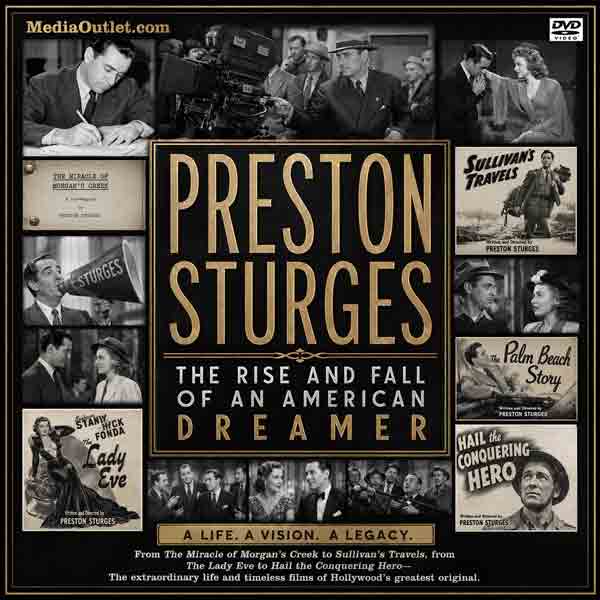
August 29, 1898: #BOTD: #HBD! Preston
Sturges, American film director, screenwriter, and playwright (d.
August 6, 1959) is #born Edmund Preston Biden in Chicago,
Illinois. In 1941, he won the Academy Award for Best Original
Screenplay for the film The Great McGinty, his first of three
nominations in the category. Sturges took the screwball comedy
format of the 1930s to another level, writing dialogue that, heard
today, is often surprisingly naturalistic, mature, and ahead of
its time, despite the farcical situations. It is not uncommon for
a Sturges character to deliver an exquisitely turned phrase and
take an elaborate pratfall within the same scene. A tender love
scene between Henry Fonda and Barbara Stanwyck in The Lady Eve was
enlivened by a horse, which repeatedly poked its nose into Fonda's
head. Prior to Sturges, other figures in Hollywood (such as
Charlie Chaplin, D.W. Griffith, and Frank Capra) had directed
films from their own scripts, however Sturges is often regarded as
the first Hollywood figure to establish success as a screenwriter
and then move into directing his own scripts, at a time when those
roles were separate. Sturges famously sold the story for The Great
McGinty to Paramount Pictures for 1 USD, in return for being
allowed to direct the film; the sum was quietly raised to 10 USD
by the studio for legal reasons. Preston Sturges died of a heart
attack at the Algonquin Hotel while writing his autobiography
(which, ironically, he had intended to title The Events Leading Up
to My Death), and was interred in the Ferncliff Cemetery in
Hartsdale, New York. His book, Preston Sturges by Preston Sturges:
His Life in His Words, was published in 1990. In 1975, he became
the first writer to be given the Screen Writers Guild's Laurel
Award posthumously. He has a star dedicated to him on the
Hollywood Walk of Fame, at 1601 Vine Street. On Sale Until
Midnight Tonight PT!
https://store.earthstation1.com/preston-sturges-the-rise-and-fall-of-an-american-dreamer-dvd.html
Today's
EarthStation1.com 15% (Or More!) Off Commemorative Memorial Title:
Dunkirk (1958) John Mills Richard Attenborough DVD, MP4, USB Drive
Today, August 29, 2026-RSS.jpg)
August 29, 1923: #BOTD: #HBD! Richard
Attenborough, English actor, Film director, entrepreneur, and
politician, President of the Royal Academy of Dramatic Art (RADA)
and the British Academy of Film and Television Arts (BAFTA), a
great and good fellow (d. August 24, 2014) is #born Richard Samuel
Attenborough in Cambridge, Cambridgeshire, England. Richard Samuel
Attenborough, Baron Attenborough, Kt (Knight Bachelor), CBE
(Commander Of The Most Excellent Order Of The British Empire)
joined the Royal Air Force during World War II and served in the
film unit. He went on several bombing raids over Europe and filmed
action from the rear gunner's position. As a film director and
producer, Attenborough won two Academy Awards for Gandhi in 1983.
He also won four BAFTA Awards and four Golden Globe Awards. As an
actor, he is perhaps best known for his roles in Brighton Rock,
The Great Escape, 10 Rillington Place, Miracle on 34th Street
(1994) and Jurassic Park. He was the older brother of David
Attenborough, a naturalist and broadcaster, and John Attenborough,
an executive at Alfa Romeo. Richard Attenborough died at Denville
Hall, Northwood, London, England, having been in poor health for
some time, including injuries sustained in a car accident, a
stroke that left him barely able to speak, and a fall as his home,
aged 90. He requested that his ashes be interred in a vault at St
Mary Magdalene church in Richmond beside those of his daughter,
Jane, and his granddaughter, Lucy, both of whom had died in the
2004 Boxing Day tsunami. He was survived by his wife of 69 years,
their oldest and youngest children, six grandchildren, two
great-grandchildren, and his younger brother David. On Sale Until
Midnight Tonight PT!
https://store.earthstation1.com/dunkirk-1958-dvd-john-mills-richard-attenborough-2-dis19582.html
Today's
EarthStation1.com 15% (Or More!) Off Commemorative Memorial Title:
WPIX at 40! (1988) New York City's TV Channel 11 DVD, Download,
USB
Today, August 29, 2026
August 29, 1941: #BOTD: #HBD! Robin
Leach, English entertainment reporter and writer from London,
England, best known for hosting the television series Lifestyles
of the Rich and Famous from 1984 to 1995 (d. August 24, 2018) is
#born Robin Douglas Leach in London, England. Beginning his career
as a print journalist, first in England and then in the United
States, his TV series focused on profiling well-known celebrities
and their lavish homes, cars and other materialistic details. His
voice has often been parodied by other actors with his signature
phrase, "champagne wishes and caviar dreams." Robin
Leach died of a stroke under hospice care in Las Vegas, 5 days
before his 77th birthday. He is buried at Palm Memorial Park in
Las Vegas, Nevada. On Sale Until Midnight Tonight PT!
https://store.earthstation1.com/wpix-at-40-channel-11-nyc-1988-tv-retrospec40111988.html
Today's
EarthStation1.com 15% (Or More!) Off Commemorative Memorial Title:
Korea: The Unknown War TV Korean War Series DVD, Download, USB
Drive
Today, August 29, 2026
August 29, 1950: Korea: The History Of
Korea: The Aftermath Of World War II: The Cold War: The Korean
Conflict: The Cold War (1947-1953): The Cold War In Asia: The
Korean War: The Battle Of The Pusan Perimeter (Korean: Busan
Gyodubo Jeontu) (The Battle Of The Naktong River Defense Line
[Korean: Nagdong-Gang Bang-Eoseon Jeontu]): -- The first British
troops, the United Kingdom's 27th Infantry Brigade, arrives in
Korea to bolster American forces in defending the Pusan perimeter.
These troops were joined by 3rd Battalion and the Royal Australian
Regiment, and the brigade was renamed as 27th British Commonwealth
Brigade due to the addition of Canadian, Australian, New Zealand
and Indian units. By the time The Battle Of Inchon (September
10-19, 1950) began two weeks later, Royal Navy ships were engaged
in the counter-offensive that started with The Inchon landing, and
the amphibious raids mounted by the Royal Marine Commandoes. On
September 16, 27 Commonwealth Brigade were involved in the
breakout from the Pusan perimeter, and by the end of October they
were advancing through North Korea as the UN forces surged
northwards. In November 1950, at the same time that the second and
much stronger British force arrived, the Chinese launched their
massive attack on UN forces moving up along the Yalu River to the
border of North Korea and China. In the west the Americans fell
back towards 27 Commonwealth Brigade while UN units within the 8th
Army fell back to the Chongchon River. Quickly defeated by Chinese
forces, the 8th Army was forced to retreat and by December 5 was
back on the 38th parallel of latitude. By January 1951, 27
Commonwealth Brigade and 29 Brigade were defending the approaches
to and from Seoul. After inflicting a sharp defeat on the
advancing Chinese, both brigades were withdrawn and Seoul was
abandoned. After months of heavy fighting UN forces checked the
Chinese advance, pushing them back beyond the Han River to
recapture Seoul. On Sale Until Midnight Tonight PT!
https://store.earthstation1.com/korea-the-unknown-war-dvd-complete-6-part-tv-series-3-dis63.html
Today's
EarthStation1.com 15% (Or More!) Off Commemorative Memorial Title:
The Age Of The Enlightenment TV College Course DVD, Download, USB
Today, August 29, 2026
August 29, 1756: The Anglo-French Wars
(1109-1815): The Second Hundred Years' War (1689-1815): The Sixty
Years' War (French: Guerre De Soixante Ans) (1754-1815): The Seven
Years' War (1756-1763): -- Frederick The Great, King of Prussia,
pre-emptively attacks the Electorate Of Saxony, a state of Holy
Roman Empire superstate, beginning in Europe the Seven Years' War,
a global conflict that involved most of the European great powers,
a world war fought primarily in Europe, the Americas, and the
Asia-Pacific (APAC) region. Conflict between Great Britain and
France broke out in 1754-1756 when the British attacked disputed
French positions in North America, while Prussia was struggling
with Austria for dominance within and outside the Holy Roman
Empire in central Europe. In 1756, the major powers "switched
partners" when the Diplomatic Revolution of 1756 reversed of
longstanding alliances in Europe - Austria went from an ally of
Britain to an ally of France, while Prussia became an ally of
Britain. The change was part of the "Stately Quadrille",
a term popularly used to describe the constantly shifting
alliances between the Great Powers of Europe during the 18th
century that occurred in order to preserve or upset the European
balance of power. As a result of these changes in alliances amid
heightening tensions with Austria, Frederick II of Prussia
realised that war was imminent, and Prussia pre-emptively struck
Saxony and quickly overran it. The result caused uproar across
Europe. The Seven Years' War was a global conflict fought between
1756 and 1763. It involved every European great power of the time
and spanned five continents, affecting Europe, the Americas, West
Africa, India, and the Philippines. The conflict split Europe into
two coalitions, led by the Kingdom of Great Britain (including
Prussia, Portugal, Hanover, and other small German states) on one
side and the Kingdom of France (including the Austrian-led Holy
Roman Empire, the Russian Empire, Bourbon Spain, and Sweden) on
the other. Meanwhile, in India, some regional polities within the
increasingly fragmented Mughal Empire, with the support of the
French, tried to crush a British attempt to conquer Bengal. The
war's extent has led some historians to describe it as "World
War Zero", similar in scale to other world wars. Although
Anglo-French skirmishes over their American colonies had begun
with what became the French And Indian War in 1754, the
large-scale conflict that drew in most of the European powers was
centered on Austria's desire to recover Silesia from the
Prussians. Seeing the opportunity to curtail Britain's and
Prussia's ever-growing might, France and Austria put aside their
ancient rivalry to form a grand coalition of their own, bringing
most of the other European powers to their side. Faced with this
sudden turn of events, Britain aligned itself with Prussia, in a
series of political manoeuvres known as the Diplomatic Revolution.
However, French efforts ended in failure when the Anglo-Prussian
coalition prevailed, and Britain's rise as among the world's
predominant powers destroyed France's supremacy in Europe, thus
altering the European balance of power. On Sale Until Midnight
Tonight PT!
https://store.earthstation1.com/the-age-of-enlightenment-5-episodes-tv-college-course-2-dv52.html
Today's
EarthStation1.com 15% (Or More!) Off Commemorative Memorial Title:
DJ Madness! 1950s-60s-70s Radio Shows DVD, MP3 Download, USB Drive
Today, August 29, 2026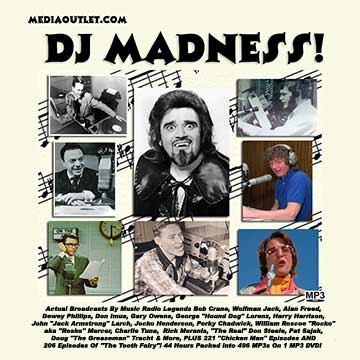
August 29, 1924: #BOTD: #HBD! Dinah
Washington, African American singer and pianist, nicknamed "The
Queen Of The Blues", the most popular black female recording
artist of the 1950s (d. December 14, 1963) is #born Ruth Lee Jones
in Tuscaloosa, Alabama. Primarily a jazz vocalist, she performed
and recorded in a wide variety of styles including blues, R &
B, early rock and roll, jazz, gospel and traditional pop music.
She was a 1986 inductee of the Alabama Jazz Hall of Fame, and was
inducted into The Rock And Roll Hall Of Fame in 1993. Dinah
Washington died early in the morning when her sixth husband,
football great Dick "Night Train" Lane, who went to
sleep with Washington, awoke to find her slumped over and not
responsive. Dr. B. C. Ross pronounced her dead at the scene at age
39. An autopsy later showed a lethal combination of secobarbital
and amobarbital, prescriptions for her insomnia and diet, which
contributed to her death. She is buried in the Burr Oak Cemetery
in Alsip, Illinois. On Sale Until Midnight Tonight PT!
https://store.earthstation1.com/dj-radio-airchecks-mp3-dvd-1950s60s70s-dis319506070.html
Today's
EarthStation1.com 15% (Or More!) Off Commemorative Memorial Title:
Color Adjustment 40 Years Of Black America On Broadcast TV DVD MP4
USB
Today, August 29, 2026
August 29, 1917: #BOTD: #HBD! Isabel
Sanford, African American stage, film, and television actress and
comedian, best known for her role as Louise "Weezy"
Mills Jefferson on the CBS sitcoms All in the Family (1971-1975)
and The Jeffersons (1975-1985) (d. July 9, 2004) is #born Eloise
Gwendolyn Sanford in Harlem, New York City. In 1981, she became
the second African-American actress to win a Primetime Emmy Award
after Gail Fisher and the first African-American actress to win
for Outstanding Lead Actress in a Comedy Series. Isabel Sanford
died at Cedars-Sinai Medical Center in Los Angeles, California at
the age of 86. Her publicist attributed it to unspecified natural
causes. She is interred at Forest Lawn Memorial Park, Hollywood
Hills in Los Angeles. For her contribution to the television
industry, Isabel Sanford has a star on the Hollywood Walk of Fame
located at 7080 Hollywood Boulevard. On Sale Until Midnight
Tonight PT!
https://store.earthstation1.com/color-adjustment-40-years-of-black-americans-on-tv-dvd-download-u40.html
Today's
EarthStation1.com 15% (Or More!) Off Commemorative Memorial Title:
Stars And Stripes: Hollywood And World War II DVD, Download, USB
Drive
Today, August 29, 2026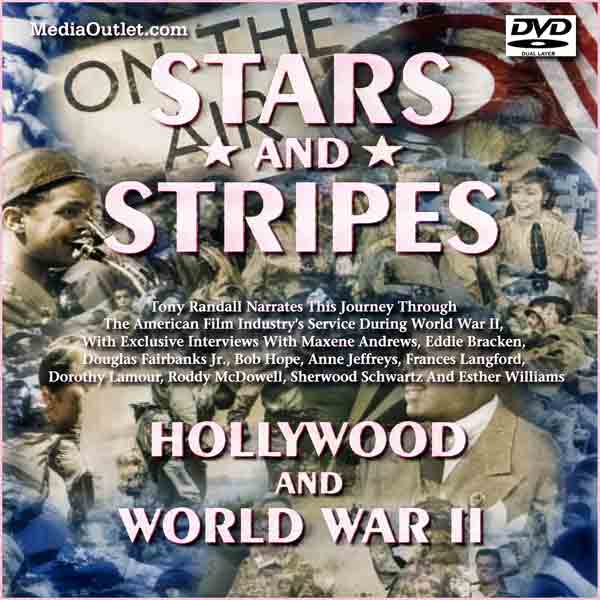
August 29, 1915: #BOTD: #HBD! Ingrid
Bergman, Swedish actress and beauty who starred in a variety of
European and American films, television movies, and plays (d.
August 29, 1982) is #born in Stockholm to a Swedish father and a
German mother. Ingrid Berman won many accolades, as a thespian who
achieved the Triple Crown of Acting with three Academy Awards, two
Primetime Emmy Awards, and a Tony Award, along with four Golden
Globe Awards, and a BAFTA Award. Bergman started her acting career
in Swedish and German films. Her introduction to Americans came in
the English-language remake of Intermezzo (1939). In addition to
the classic and Best Picture Academy Award-winning Casablanca
(1942) opposite Humphrey Bogart, her notable performances from the
1940s include the dramas For Whom the Bell Tolls (1943), Gaslight
(1944), The Bells of St. Mary's (1945), and Joan Of Arc (1948),
all of which earned her nominations for the Academy Award for Best
Actress; she won the award for Gaslight. She made three films with
Alfred Hitchcock including Spellbound (1945), with Gregory Peck,
and Notorious (1946), opposite Cary Grant. In 1950, she starred in
Roberto Rossellini's Stromboli, following the revelation that she
was having an extramarital affair with the director, who she
eventually married. The subsequent scandal affected her US career,
and she remained in Europe, starring in Rossellini's now acclaimed
Journey to Italy (1954). She returned to Hollywood for Anastasia
(1956), the debut film for Yul Brynner, winning her second Academy
Award for Best Actress. She continued to attract critical acclaim
and won a third Academy Award for a small role in Murder on the
Orient Express (1974). According to the St. James Encyclopedia of
Popular Culture, Bergman quickly became "the ideal of
American womanhood" and a contender for Hollywood's greatest
leading actress. In the United States, she is considered to have
brought a "Nordic freshness and vitality" to the screen,
along with exceptional beauty and intelligence; David O. Selznick
once called her "the most completely conscientious actress"
he had ever worked with. In 1999, the American Film Institute
ranked Bergman as the fourth-greatest female screen legend of
Classic Hollywood Cinema. After the onset of World War II, Bergman
"felt guilty because she had so misjudged the situation in
Germany" while she was there filming Die vier Gesellen (The
Four Companions). According to one of her biographers, Charlotte
Chandler (2007), she had at first considered the Nazis only a
"temporary aberration, 'too foolish to be taken seriously'.
She believed Germany would not start a war." Bergman felt
that "the good people there would not permit it".
Chandler adds, "Ingrid felt guilty all the rest of her life
because when she was in Germany at the end of the war, she had
been afraid to go with the others to witness the atrocities of the
Nazi extermination camps". On Sale Until Midnight Tonight PT!
https://store.earthstation1.com/stars-and-stripes-hollywood-and-world-war-ii-dvd.html
Today's
EarthStation1.com #OnThisDay Commemorative Memorial Title: Future
Wars: Then And Now - Foreseen Warcraft Today MP4 Download DVD
Today, August 29, 2026 August 29, 1990: Product Rollouts: -- The
first YF-22 (PAV-1, serial number 87-0700, N22YF), with a General
Electric GE YF120 engine, later to become known as the F-22
Raptor, is first rolled out. On September 29, 1990, it would fly
for the first time from Palmdale, taking off the Lockheed's
Palmdale, California Skunk Works facility, piloted by David L.
Ferguson. uring the 18-minute flight, PAV-1 reached a maximum
speed of 250 knots (460 km/h; 290 mph) and a height of 12,500 feet
(3,800 m), before landing at Edwards AFB. Following the flight,
Ferguson said that the remainder of the YF-22 test program would
be concentrated on "the manoeuvrability of the aeroplane,
both supersonic and subsonic". The second YF-22 (PAV-2, s/n
87-0701, N22YX) with the Pratt And Whitney P & W YF119 engine,
made its maiden flight on October 30 at the hands of Tom
Morgenfeld. The Lockheed/Boeing/General Dynamics YF-22 is an
American single-seat, twin-engine fighter aircraft technology
demonstrator designed for the United States Air Force (USAF). The
design was a finalist in the USAF's Advanced Tactical Fighter
competition, and two prototypes were built for the
demonstration/validation phase of the competition. The YF-22 won
the contest against the Northrop YF-23, and was developed into the
Lockheed Martin F-22 Raptor. The YF-22 has a similar aerodynamic
layout and configuration as the F-22, but with differences in the
position and design of the cockpit, tail fins and wings, and in
internal structural layout. In the 1980s, the USAF began looking
for a replacement for its fighter aircraft, especially to counter
the advanced Su-27 and MiG-29. A number of companies, divided into
two teams, submitted their proposals. Northrop and McDonnell
Douglas submitted the YF-23. Lockheed, Boeing and General Dynamics
proposed and built the YF-22, which, although marginally slower
and having a larger radar cross-section, was more agile than the
YF-23. Primarily, for this reason, it was picked by the Air Force
as the winner of the ATF in April 1991. Following the selection,
the first YF-22 was retired to a museum, while the second
prototype continued flying until an accident relegated it to the
role of an antenna test vehicle.
https://store.earthstation1.com/future-wars-then-and-now--foreseen-warcraft-today-mp4-download-dv4.html
August 29, 1990: Product Rollouts: -- The
first YF-22 (PAV-1, serial number 87-0700, N22YF), with a General
Electric GE YF120 engine, later to become known as the F-22
Raptor, is first rolled out. On September 29, 1990, it would fly
for the first time from Palmdale, taking off the Lockheed's
Palmdale, California Skunk Works facility, piloted by David L.
Ferguson. uring the 18-minute flight, PAV-1 reached a maximum
speed of 250 knots (460 km/h; 290 mph) and a height of 12,500 feet
(3,800 m), before landing at Edwards AFB. Following the flight,
Ferguson said that the remainder of the YF-22 test program would
be concentrated on "the manoeuvrability of the aeroplane,
both supersonic and subsonic". The second YF-22 (PAV-2, s/n
87-0701, N22YX) with the Pratt And Whitney P & W YF119 engine,
made its maiden flight on October 30 at the hands of Tom
Morgenfeld. The Lockheed/Boeing/General Dynamics YF-22 is an
American single-seat, twin-engine fighter aircraft technology
demonstrator designed for the United States Air Force (USAF). The
design was a finalist in the USAF's Advanced Tactical Fighter
competition, and two prototypes were built for the
demonstration/validation phase of the competition. The YF-22 won
the contest against the Northrop YF-23, and was developed into the
Lockheed Martin F-22 Raptor. The YF-22 has a similar aerodynamic
layout and configuration as the F-22, but with differences in the
position and design of the cockpit, tail fins and wings, and in
internal structural layout. In the 1980s, the USAF began looking
for a replacement for its fighter aircraft, especially to counter
the advanced Su-27 and MiG-29. A number of companies, divided into
two teams, submitted their proposals. Northrop and McDonnell
Douglas submitted the YF-23. Lockheed, Boeing and General Dynamics
proposed and built the YF-22, which, although marginally slower
and having a larger radar cross-section, was more agile than the
YF-23. Primarily, for this reason, it was picked by the Air Force
as the winner of the ATF in April 1991. Following the selection,
the first YF-22 was retired to a museum, while the second
prototype continued flying until an accident relegated it to the
role of an antenna test vehicle.
https://store.earthstation1.com/future-wars-then-and-now--foreseen-warcraft-today-mp4-download-dv4.html
Today's
EarthStation1.com #OnThisDay Commemorative Memorial Title: The
Guns Of August (1964) WWI Film DVD, Video Download, USB Drive
Today, August 29, 2026August 29, 1914: The European Civil War:
World War I: The First European War (The European Theater Of World
War I): The Guns Of August: The Western Front Of World War I: The
Battle Of Mons: The Great Retreat (French: "La Grande
Retraite", The Retreat From Mons): The Battle Of St. Quentin
(The First Battle Of Guise [French: 1ere Bataille De Guise])
(August 29-30, 1914): -- The Battle of St. Quentin begins when the
French Fifth Army counter-attacks the invading Germans at
Saint-Quentin, Aisne. On the night of August 26, the Allies
withdrew from Le Cateau to St. Quentin. With retreat all along the
line, the commander-in-chief of the French forces, Joseph Joffre,
needed the Fifth Army (General Charles Lanrezac) to hold off the
German advance with a counter-attack, despite a 4 mi (6.4 km)
separation from the French Fourth Army on the right flank and the
continual retreat of the British Expeditionary Force (BEF) on the
left flank. The movement of the Fifth Army took most of August 28,
turning from facing north to facing west against St. Quentin. On
August 29, the Fifth Army attacked St. Quentin with their full
force. The Germans captured orders from a French officer and
General Karl von Bulow, commander of the German 2nd Army had time
to prepare. The attacks against the town by the XVIII corps was a
costly failure but X and III corps on the right were rallied by
the commander of I Corps, General Louis Franchet d'Esperey.
Advances on the right were made against Guise and forced the
Germans, including the Guard Corps, to fall back. That night,
Joffre ordered Lanrezac to resume his retreat and destroy the
bridges over the Oise as he fell back. The orders did not reach
the Fifth Army until the morning of August 30, and the retreat
began several hours late. The move went unchallenged by the 2nd
Army, which neither attacked nor pursued. Bulow found that the 2nd
Army was separated by the Oise, which offered the possibility of
enveloping the French attack with counter-attacks from both
flanks. The risk that the French could exploit the 15 km (9.3 mi)
gap between the inner flanks of the 2nd Army, led Bulow to choose
a cautious policy of preventing the danger and ordered the corps
on the inner flanks to close up and counter-attack the French X
Corps. Later in the afternoon French attacks were repulsed and the
14th Division was ordered to advance from the Somme area to
intervene in the battle. The divisional commander ignored the
order to let the division rest and prepare for an advance on La
Fere to get behind the Fifth Army. Lieutenant-General Karl von
Einem the VII Corps commander was overruled and all corps of the
2nd Army were ordered to attack and obtain a decisive victory.
Bulow reported the battle to Oberste Heeresleitung (OHL, supreme
command of the German armies) by wireless as a victory but during
the night, captured documents revealed that thirteen French
divisions had attacked 6_ German divisions. Bulow sent a staff
officer to the 1st Army (General Alexander von Kluck), to request
support for the attack on August 30. Doubts emerged that the Guard
Corps could attack in the morning due to exhaustion and the
commander was authorised to withdraw behind the Oise if necessary;
the possibility of enveloping the French left flank had passed and
operations for local advantage were ordered for the morning. The
French resumed the offensive on the morning of August 30 but
managed only disjointed attacks which were repulsed; German
counter-attacks began before noon. The terrain in the Oise valley
was marshy, cut by deep streams and covered by underbrush, with
rising ground beyond. German infantry made slow progress through
extensive artillery bombardments by both sides. By early
afternoon, aircraft reconnaissance reports showed that the French
had begun to withdraw behind rearguards. Bulow ordered a pursuit
by small infantry parties with field artillery, while the main
force paused to rest, due to exhaustion and to concern that the
fortress of La Fere obstructed a general advance and would have to
be masked while the 1st Army enveloped the French from the west
and then attacked on September 1. The 2nd Army pursuit by small
forces took only four guns, 16 machine-guns and approx. 1,700
prisoners.
https://store.earthstation1.com/the-guns-of-august-dvd-1964-world-war-i-movie-documen1964.html
Today's
EarthStation1.com #OnThisDay Commemorative Memorial Title: Eamon
de Valera Documentary DVD, Video Download, USB Flash Drive
Today, August 29, 2026August 29, 1975: #DOTD: #RIP: Eamon de
Valera, Irish soldier, statesman and political leader, 3rd
President of Ireland (b. October 14, 1882) #dies of pneumonia and
heart failure at Linden Convalescent Home, Blackrock, Dublin, aged
92. His wife, Sinead de Valera, four years his senior, had died
the previous January, on the eve of their 65th wedding
anniversary. His body lay in state at Dublin Castle and was given
a full state funeral on September 3 at St Mary's Pro-Cathedral,
which was broadcast on national television. Over 200,000 people
reportedly lined the three-mile funeral route from Dublin city
centre to Glasnevin Cemetery. He is buried in Glasnevin alongside
his wife and son Brian. Eamon de Valera was born at the Nursery
and Child's Hospital, Lexington Avenue, New York City, a home for
destitute orphans and abandoned children, the son of Catherine
Coll, who was originally from Bruree, County Limerick, and Juan
Vivion de Valera, described on the birth certificate as a Spanish
artist born in 1853. Some researchers have placed his father's
place of birth in Cuba, while others have suggested other
locations; according to Antonio Rivero Taravillo, he was born in
Seville, while Ronan Fanning has him born in the Basque Country.
His parents were reportedly married on September 18 1881 at St
Patrick's Church in Jersey City, New Jersey, but archivists have
not located any marriage certificate or any birth, baptismal, or
death certificate information for anyone called Juan Vivion de
Valera (nor for "de Valeros", an alternative spelling).
On de Valera's original birth certificate, his name is given as
George de Valero and his father is listed as Vivion de Valero.
Although he was known as Edward de Valera before 1901, a fresh
birth certificate was issued in 1910, in which his first name was
officially changed to Edward and his father's surname given as "de
Valera". As a child, he was known as "Eddie" or
"Eddy". According to Eamon's mother Catherine Coll, Juan
Vivion died in 1885, leaving Coll and her child in poor
circumstances. Eamon was taken to Ireland by his uncle Ned at the
age of two. When his mother remarried in the mid-1880s, he was not
brought back to live with her, but was reared by his grandmother,
Elizabeth Coll, her son Patrick and her daughter Hannie, in
Bruree, County Limerick. He was educated locally at Bruree
National School, County Limerick and C.B.S. Charleville, County
Cork. Aged sixteen, he won a scholarship. He was not successful in
enrolling at two colleges in Limerick, but was accepted at
Blackrock College, Dublin, at the instigation of his local curate.
He played rugby at Blackrock and Rockwell College, then for
Munster around 1905. He remained a lifelong devotee of rugby,
attending international matches even towards the end of his life
when he was nearly blind. At the end of his first year at
Blackrock College he was student of the year. He also won further
scholarships and exhibitions and in 1903 was appointed teacher of
mathematics at Rockwell College, County Tipperary. Eamon de
Valera's political career spanned over half a century, from 1917
to 1973; he served several terms as head of government and head of
state. He also led the introduction of the Constitution of
Ireland. Prior to de Valera's political career, he was a
Commandant at Boland's Mill during the 1916 Easter Rising, an
Irish revolution that eventually contributed to Irish
independence. He was arrested, sentenced to death but released for
a variety of reasons, including the public response to the British
execution of Rising leaders. He returned to Ireland after being
jailed in England and became one of the leading political figures
of the War of Independence. After the signing of the Anglo-Irish
Treaty, de Valera served as the political leader of Anti-Treaty
Sinn Fein until 1926, when he, along with many supporters, left
the party to set up Fianna Fail, a new political party which
abandoned the policy of abstentionism from Dail Eireann. From
there, de Valera went on to be at the forefront of Irish politics
until the turn of the 1960s. He took over as President of the
Executive Council from W. T. Cosgrave and later Taoiseach, with
the passing of Bunreacht Na hEireann (Irish constitution) in 1937.
He served as Taoiseach on 3 occasions; from 1937 to 1948, from
1951 to 1954 and finally from 1957 to 1959. He remains the longest
serving Taoiseach by total days served in the post. He resigned in
1959 upon his election as President of Ireland. By then, he had
been Leader of Fianna Fail for 33 years, and he, along with older
founding members, began to take a less prominent role relative to
newer ministers such as Jack Lynch, Charles Haughey and Neil
Blaney. He would serve as President from 1959 to 1973, two full
terms in office. De Valera's political beliefs evolved from
militant Irish republicanism to strong social, cultural and
economic conservatism. He has been characterised by a stern,
unbending, devious demeanour. His roles in the Civil War have also
portrayed him as a divisive figure in Irish history. Biographer
Tim Pat Coogan sees his time in power as being characterised by
economic and cultural stagnation, while Diarmaid Ferriter argues
that the stereotype of de Valera as an austere, cold and even
backward figure was largely manufactured in the 1960s and is
misguided.
https://store.earthstation1.com/eamon-de-valera-dvd-irish-civil-war-leader-and-president.html
Today's
EarthStation1.com #OnThisDay Commemorative Memorial Title: The
Incas Remembered: Historical Documentary DVD, MP4, USB Stick
Today, August 29, 2026August 29, 1533: #DOTD: #RIP: Atahualpa
{Atawallpa Quechua), also Atabalica, Atahuallpa, Atabalipa (in
Hispanicized spellings)}, the last Inca Emperor (b. c. 1497) is
buried, after having been executed by the Spanish on July 26,
1533. After several months in fear of an imminent attack from the
Inca Resistance general Ruminahui, the outnumbered Spanish
considered Atahualpa to be too much of a liability and decided to
execute him. Pizarro staged a mock trial and found Atahualpa
guilty of revolting against the Spanish, practicing idolatry, and
murdering his brother Huascar. Atahualpa was sentenced to death by
burning at the stake. He was horrified, since the Inca believed
that the soul would not be able to go on to the afterlife if the
body were burned. Friar Vincente de Valverde, who had earlier
offered his breviary to Atahualpa, intervened, telling Atahualpa
that, if he agreed to convert to Catholicism, the friar could
convince Pizarro to commute the sentence. Atahualpa agreed to be
baptized into the Catholic faith. He was given the name Francisco
Atahualpa in honor of Francisco Pizarro. On the morning of his
death, Atahualpa was interrogated by his Spanish captors about his
birthplace. Atahualpa declared that his birthplace was in what the
Incas called the Kingdom of Quito, in a place called Caranqui
(today located 2 km southeast of Ibarra, Ecuador). Most
chroniclers suggest that Atahualpa was born in what the Incas used
to call the Kingdom of Quito, though other stories suggest various
other birthplaces. In accordance with his request, he was executed
by strangling with a garrote on July 26. 1533. His clothes and
some of his skin was burned, and his remains were given a
Christian burial on August 28, 1533; the exact location of
Atahualpa's grave is unknown, but there is a consensus of opinion
that it is at Malqui-Machay in Ecuador. Atahualpa was succeeded by
his brother Tupac Huallpa, and later by another brother, Manco
Inca. After defeating his brother, Atahualpa became very briefly
the last Sapa Inca (sovereign emperor) of the Inca Empire
(Tawantinsuyu) before the Spanish conquest ended his reign. Before
the Inca Emperor Huayna Capac died in Quito in 1524 (possibly due
to smallpox, a disease brought by Europeans), he had appointed his
son Ninan Cuyochi as his successor. Ninan died of the same
disease. The Cusquenian nobles named Huascar (another son of
Huayna) as Sapa Inca, and he appointed his brother Atahualpa as
governor of Quito. The Inca Civil War began in 1529 when Huascar
declared war on Atahualpa, for fear that he would try to carry out
a coup d'etat against him. Atahualpa became Inca emperor in May
1532 after he had defeated and imprisoned Huascar and massacred
any pretenders to the throne. The Spaniard Francisco Pizarro
captured Atahualpa in November 1532 and used him to control the
Inca Empire. While imprisoned by the Spaniards, Atahualpa gave
orders to kill Huascar in Jauja, thinking Huascar would use the
Spaniards as allies to regain his throne. The Spanish eventually
executed Atahualpa, effectively ending the empire. A succession of
emperors, who led the Inca resistance against the invading
Spaniards, claimed the title of Sapa Inca as rulers of the
Neo-Inca State, but the empire began to disintegrate after
Atahualpa's death.
https://store.earthstation1.com/the-incas-remembered-historical-documentary-dvd-mp4-us4.html
Today's
EarthStation1.com #OnThisDay Commemorative Memorial Title: TV
Commercials: The Classics Vol. 1 DVD, Video Download, USB Drive
Today, August 29, 2026August 29, 2016: #DOTD: #RIP: Gene
Wilder, American actor, comedian, writer, filmmaker, director and
screenwriter (b. June 11, 1933) #dies from complications of
Alzheimer's disease in Stamford, Connecticut while listening to
one of his favorite songs, a rendition of "Over the Rainbow"
sung by Ella Fitzgerald, aged 83. He had been diagnosed 3 years
before his death but kept knowledge of his condition private.
Wilder's nephew Jordan Walker-Pearlman said that this was done to
not sadden fans of Willy Wonka & the Chocolate Factory,
stating "The decision to wait until this time to disclose his
condition wasn't vanity, but more so that the countless young
children that would smile or call out to him 'there's Willy
Wonka,' would not have to be then exposed to an adult referencing
illness or trouble and causing delight to travel to worry,
disappointment, or confusion. He simply couldn't bear the idea of
one less smile in the world." Mel Brooks, as a guest on The
Tonight Show with Jimmy Fallon, spoke about his grief, stating:
"He was such a dear friend. I expected that he would go --
but when it happens, it's still tremendous. It's a big shock. I'm
still reeling. No more Gene? ... He was such a wonderful part of
my life." Various celebrities shared their grief for the
comedian on Twitter such as Carl Reiner, Albert Brooks, Billy
Crystal, Julia Louis Dreyfus, and Russell Crowe. James Corden gave
a tribute to Wilder on his show The Late Late Show with James
Corden saying "He was just a magical person, and he made
everybody around him feel this incredible feeling of joy".
Wilder was included in the Academy of Motion Pictures Arts and
Sciences In Memoriam montage during the Oscars telecast. His
remains were cremated, and his ashes scattered in the backyard of
his Stamford, Connecticut home. Gene Wilder was born Jerome
Silberman in Milwaukee, Wisconsin, the son of Jeanne (Baer) and
William J. Silberman, a manufacturer and salesman of novelty
items. His father was a Russian-Jewish immigrant, as were his
maternal grandparents. He was known mainly for his comedic roles,
but also for his portrayal of Willy Wonka in Willy Wonka & the
Chocolate Factory (1971). He collaborated with Mel Brooks on the
films The Producers (1967), Blazing Saddles (1974) and Young
Frankenstein (1974), as well as with Richard Pryor in the films
Silver Streak (1976), Stir Crazy (1980), See No Evil, Hear No Evil
(1989) and Another You (1991).[1] He also starred in Woody Allen's
Everything You Always Wanted to Know About Sex* (*But Were Afraid
to Ask) (1972). Wilder began his career on stage, and made his
screen debut in an episode of the TV series The Play of the Week
in 1961. Although his first film role was portraying a hostage in
the 1967 motion picture Bonnie and Clyde, Wilder's first major
role was as Leopold Bloom in the 1967 film The Producers, for
which he was nominated for an Academy Award for Best Supporting
Actor. This was the first in a series of collaborations with
writer/director Mel Brooks, including 1974's Blazing Saddles and
Young Frankenstein, which Wilder co-wrote, garnering the pair an
Academy Award nomination for Best Adapted Screenplay. Wilder
directed and wrote several of his own films, including The Woman
in Red (1984). With his third wife, Gilda Radner, he starred in
three films, the last two of which he also directed. Her 1989
death from ovarian cancer led to his active involvement in
promoting cancer awareness and treatment, helping found the Gilda
Radner Ovarian Cancer Detection Center in Los Angeles and
co-founding Gilda's Club. After his last acting performance in
2003 - a guest role on Will & Grace for which he received an
Emmy Award for Outstanding Guest Actor - Wilder turned his
attention to writing. He produced a memoir in 2005, Kiss Me Like a
Stranger: My Search for Love and Art; a collection of stories,
What Is This Thing Called Love? (2010); and the novels My French
Whore (2007), The Woman Who Wouldn't (2008), and Something to
Remember You By (2013).
https://store.earthstation1.com/tv-commercials-the-classics-vol-1-dv1.html
Today's
EarthStation1.com #OnThisDay Commemorative Memorial Title:
Hollywood The Golden Years: The RKO Story DVD, Download, USB Drive
Today, August 29, 2026August 29, 2021: #DOTD: #RIP: Ed Asner,
American actor and former president of the Screen Actors Guild,
the most honored male performer in the history of the Primetime
Emmy Awards (b. November 15, 1929) #dies of natural causes in the
morning at his home in the Tarzana neighborhood of Los Angeles,
California, at the age of 91. He was buried at Sheffield Cemetery
in Kansas City, Missouri, on September 12, 2021. Ed Asner was born
Eddie Asner in Kansas City, Missouri to Ashkenazi Jewish immigrant
parents: his housewife mother Lizzie (nee Seliger, from Odessa,
Ukraine), and father Morris David Asner from Vilna (modern
Vilnius), Lithuania, who ran a second-hand shop and junkyard. He
grew up in Kansas City, Kansas. Ed Asner is best remembered for
portraying Lou Grant during the 1970s and early 1980s, on both The
Mary Tyler Moore Show and its spin-off series Lou Grant, making
him one of the few television actors to portray the same character
in both a comedy and a drama. Asner won seven (7) Primetime Emmy
Awards - five for portraying Lou Grant (three as Supporting Actor
in a Comedy Television Series on The Mary Tyler Moore Show and two
as Lead Actor in a Dramatic Television Series on spin-off Lou
Grant). His other Emmys were for performances in two television
miniseries: Rich Man, Poor Man (1976), for which he won the
Outstanding Lead Actor for a Single Performance in a television
series award, and Roots (1977), for which he won the Outstanding
Single Performance by a Supporting Actor in a television series
award. Asner also played John Wayne's adversary Bart Jason in the
1966 Western El Dorado. He played Santa Claus in several films,
including in 2003's Elf. In 2007, he voiced the main villain Krad
in Christmas Is Here Again. In 2009, he voiced Carl Fredricksen in
Pixar's animated film Up and made a guest appearance on CSI: NY in
the episode "Yahrzeit". In early 2011, Asner returned to
television as butcher Hank Greziak in Working Class, the first
original sitcom on cable channel CMT. He starred in Michael,
Tuesdays and Thursdays, on CBC Television and appeared in The
Glades. Asner guest-starred as Guy Redmayne in the sixth season of
The Good Wife. He had a guest role in Cobra Kai, appearing as Sid
Weinberg in seasons one and three. In 2020, he had a recurring
role as James Staghorne Sr. on Briarpatch.
https://store.earthstation1.com/hollywood-the-golden-years-the-rko-story-dvd-set-2-disc2.html
Today's
EarthStation1.com #OnThisDay Commemorative Memorial Title: Hi-Yo
Silver! (1940) The Lone Ranger Feature Film DVD, MP4, USB Stick
Today, August 29, 2026August 29, 1916: #BOTD: #HBD! George
Montgomery, American actor, painter, director, producer, writer,
sculptor, furniture craftsman, businessman and stuntman (d.
December 12, 2000) is #born George Montgomery Letz in Brady, in
Pondera County, northern Montana near Great Falls. He is best
remembered as an actor in Western films and television. Having
been briefly engaged to Hedy Lamarr, he was a long-time husband of
Dinah Shore, with whom he had two children. He was the youngest of
15 children of Ukrainian immigrant parents, from Mykolaiv in
southern Ukraine. He was reared on a large ranch, where he learned
to ride horses and work cattle as a part of daily life. Letz boxed
as a heavyweight for a short while before enrolling in the
University of Montana in Missoula. He was active in school
athletics and majored in interior design, but he left after one
year. Montgomery was more interested in a career in film than in a
college education. Therefore, he left Montana for Hollywood. Two
days after his arrival there, he was working as a stunt man on a
Greta Garbo film at MGM, Conquest (1937). At Republic Pictures,
his cowboy skills gained him stunt work and a small acting part at
the age of 18 in a 1935 Gene Autry film, The Singing Vagabond. He
followed this with bit parts and additional stunt work as "George
Letz" in many mostly low-budget films, nearly all westerns.
In 1938, he appeared as one of the six men suspected of being the
titular hero in The Lone Ranger. That year, Life included him in a
photo montage of "Hollywood's Movie-struck Kids" and
described Montgomery, still using his full name, as "6 ft. 3
in. tall, weighs 210 lb., rides well, is superlatively handsome."
In 1939, he signed with 20th Century Fox, which billed him as
George Montgomery. Montgomery was promoted to leading roles in a
melodrama written by Dalton Trumbo, Accent on Love (1941). In the
1958-59 season, Montgomery starred in his own 26-episode NBC
Western series, Cimarron City as Mayor Matt Rockford, with
co-stars John Smith and Audrey Totter through his own production
company Mont Productions. Montgomery claimed to have turned down
the lead roles in the Western television series Gunsmoke and Wagon
Train. In 1963, Montgomery's private life made headlines when his
housekeeper was charged in a failed attempt to kill him. Allegedly
suffering from a fanatical attraction to her employer, the woman
planned to shoot Montgomery, then take her own life. As a boy,
George Montgomery had developed excellent craftsmanship with wood.
As an adult, he began building furniture, first for himself and
then for a few friends. His skill was such that his hobby became a
full-fledged cabinet-making business, in which he employed as many
as 20 craftsmen. Montgomery oversaw the furniture business for
more than 40 years, and expanded his interest to house design. He
became involved with the building of 11 homes for friends and
family. His artistic instincts included learning how to sculpt in
bronze. Self-taught, he sculpted upwards of 50 bronze sculptures
of subjects such as John Wayne, Clint Eastwood, Gene Autry,
Randolph Scott, and Ronald W. Reagan. He received renown in
particular for a sculpture he did of Custer's Last Stand. His
sculpture of his former wife, Dinah Shore, and their children is
displayed at the Mission Hills Country Club in Rancho Mirage,
California. Montgomery died at his home in Rancho Mirage,
California aged 84 in the presence of his daughter Melissa, his
companion Ann Lindberg, and his friend Patrick Curtis. He was
cremated, and his ashes were divided and interred at Forest Lawn
Cemetery in Cathedral City near his Palm Springs, California home
and at the Highland Cemetery in Great Falls, Montana, near his
birthplace.
https://store.earthstation1.com/hiyo-silver1940-dvd-the-lone-ranger-feature-1940.html
Today's
EarthStation1.com #OnThisDay Commemorative Memorial Title: The
Moving Picture Boys In The Great War: WWI DVD, Download, USB Drive
Today, August 29, 2026August 29, 1981: #DOTD: #RIP: Lowell
Thomas, American author, journalist, tv broadcaster, radio
broadcaster and traveler, best remembered for publicizing T. E.
Lawrence (Lawrence Of Arabia) (b. August 29, 1892) #dies at his
home in Pawling, New York. aged 89. He is buried in Christ Church
Cemetery in Pauling. Lowell Thomas was born Lowell Jackson Thomas
in Woodington, Ohio. Thomas shot dramatic footage of Lawrence and,
after the war, toured the world, narrating his film "With
Allenby in Palestine and Lawrence in Arabia", and making
Lawrence, and himself, household names. During the 1920s, Thomas
was a magazine editor, but he never lost his fascination with the
movies. He narrated Twentieth Century Fox's Movietone newsreels
until 1952. That year, he went into business with Mike Todd and
Merian C. Cooper to exploit Cinerama, a movie format that used
three projectors and an enormous curved screen with 7-channel
surround sound. He produced the first movie/documentary in
Cinerama: This is Cinerama, the third: Seven Wonders of the World,
and the fourth: Search for Paradise in this format in 1956, with a
1957 release date. Cinerama features were well-received, but the
company discontinued the three-projector system by 1963, with the
enormous costs and technical difficulties in film production and
presentation, in favor of a single-camera 70mm system which lacked
the visual impact of true Cinerama. A quarter-century later,
Thomas was still raving about Cinerama in his memoirs and
wondering why someone wasn't trying to revive it. He hosted the
first-ever television news broadcast in 1939 and the first
regularly scheduled television news broadcast (even though it was
just a camera simulcast of his radio broadcast) beginning on
February 21, 1940 over local station W2XBS (now WNBC) New York. In
the summer of 1940, Thomas anchored the first live telecast of a
political convention, the 1940 Republican National Convention
which was fed from Philadelphia to W2XBS and on to W2XB.
Reportedly, Thomas wasn't even in Philadelphia, instead anchoring
the broadcast from a New York studio and merely identifying
speakers who addressed the convention. He presented and commented
upon the news for four decades until his retirement in 1976, the
longest radio career of anyone in his day (a record later
surpassed by Paul Harvey). "No other journalist or world
figure, with the possible exception of Winston Churchill, has
remained in the public spotlight for so long," wrote Norman
R. Bowen in Lowell Thomas: The Stranger Everyone Knows (1968). His
signature sign-on was "Good evening, everybody" and his
sign-off "So long, until tomorrow," phrases that he
would use in titling his two volumes of memoirs. Thomas is also
known for two television programs: High Adventure, a series of
travelogue specials filmed in the late 1950s for CBS; and Lowell
Thomas Remembers, a 1970s PBS series that reviewed major news
events from 1919 through 1975 on a year-by-year basis using
newsreel footage, including some that Thomas originally narrated
for Movietone. He was also involved in promoting the Polaroid
cameras in instructional films.
https://store.earthstation1.com/the-moving-picture-boys-in-the-great-war-dvd.html
Today's
EarthStation1.com #OnThisDay Commemorative Memorial Title: WABC
Radio Airchecks MP3 Collection 1960s-1980s DVD, MP3 Download, USB
Today, August 29, 2026August 29, 2021: #DOTD: #RIP: Ron Bushy,
American drummer best known as a member of the rock band Iron
Butterfly and as the drum soloist on the band's iconic song
"In-A-Gadda-Da-Vida" released on LP on June 14, 1968 and
as a single on July 31, 1968 (b. December 23, 1941) #dies in the
morning at the UCLA Medical Center in Santa Monica following a
battle with esophageal cancer, at the age of 79. He is buried at
Mount Sinai Memorial Park in Hollywood Hills, California. Ron
Bushy was born Ronald Edgar Bushy in Washington, D.C.. Bushy was
the only member of the group to appear on all six of its studio
albums. They are best known for the 1968 hit "In-A-Gadda-Da-Vida",
providing a dramatic sound that led the way towards the
development of hard rock and heavy metal music. The song was
originally written by the band's vocalist and keyboardist Doug
Ingle as "In The Garden Of Eden", but as a result of
singing the first draft whilst intoxicated, the title was misheard
by Bushy as "In-A-Gadda-Da-Vida", and the name of the
song was thus changed. Itwent to number thirty on the Billboard
Hot 100, and charted highest in the Netherlands, where it went to
number seven.
https://store.earthstation1.com/wabc-musicradio-shows-mp3-dvd-60s80s-am-360807775.html
Today's
EarthStation1.com #OnThisDay Commemorative Memorial Title: The
Gulf Crisis: The Road To War TV Series + Bonus 2 DVDs MP4 Download
Today, August 29, 2026August 29, 1990: The Aftermath Of World
War II: The Cold War: The Cold War (1985-1991) (The End Of The
Cold War): The Gulf War (The Persian Gulf War, Gulf War I): The
Invasion Of Kuwait: -- United Nations Secretary-General Javier
Perez de Cuellar travels to Baghdad to meet Foreign Minister of
Iraq Tariq Aziz. On August 18, 1990, United Nations Security
Council Resolution 664 (UNSCR 664) was adopted unanimously, which
recalled Iraq's obligations under international law and acting
under Chapter VII of the United Nations Charter, demanded that
Iraq permit and facilitate the departure of nationals from third
countries from within Iraq and Kuwait, calling for consular and
diplomatic access to the third state nationals. UNSCR 664 further
reaffirmed resolutions UNSCR 660, adopted August 2, which
condemned the invasion and demanded Iraq withdraw immediately and
unconditionally to positions as they were on August 1. 1990; UNSCR
661 of August 6, which took steps to implement international
sanctions on Iraq; and UNSCR 662, adopted unanimously August 9,
which declared the annexation of Kuwait by Iraq illegal in any
form. UNSCR 664 went on to demand that Iraq take no action that
would jeopardise the safety of the nationals, reaffirming that the
annexation of Kuwait is illegal, therefore demanding that Iraq
rescind its orders to close consular and diplomatic missions in
Kuwait and the removal of diplomatic immunity of their personnel.
Thousands of foreigners were in Iraq and Kuwait at the time of the
Iraqi invasion, and the Council denounced Iraq's decision to use
foreign nationals as "human shields" at strategic sites.
It finally requested the Secretary-General Javier Perez de Cuellar
to report on the compliance with the current resolution as soon as
possible. Operation Desert Shield had been officially launched on
August 8, as the day before that President George Bush ordered a
massive military buildup to prevent further Iraqi military
advances, with the first American soldiers being sent to Saudi
Arabia that same day: 15,000 U.S. troops, 32 destroyers and 100
helicopters and fighter planes. Soon after his conquest of Kuwait,
Saddam began verbally attacking the Saudis. He argued that the
US-supported Saudi state was an illegitimate and unworthy guardian
of the holy cities of Mecca and Medina. He combined the language
of the Islamist groups that had recently fought in Afghanistan
with the rhetoric Iran had long used to attack the Saudis. Acting
on the Carter Doctrine's policy that the United States would use
military force, if necessary, to defend its national interests in
the Persian Gulf, and out of fear the Iraqi Army could launch an
invasion of Saudi Arabia, US President George Bush quickly
announced that the US would launch a "wholly defensive"
mission to prevent Iraq from invading Saudi Arabia under the
codename Operation Desert Shield. Operation Desert Shield began on
7 August 1990 when US troops were sent to Saudi Arabia due also to
the request of its monarch, King Fahd, who had earlier called for
US military assistance. This "wholly defensive" doctrine
was quickly abandoned when, on 8 August, Iraq declared Kuwait to
be Iraq's 19th province and Saddam named his cousin, Ali Hassan
Al-Majid, as its military-governor. The US Navy dispatched two
naval battle groups built around the aircraft carriers USS Dwight
D. Eisenhower and USS Independence to the Persian Gulf, where they
were ready by 8 August. The US also sent the battleships USS
Missouri and USS Wisconsin to the region. A total of 48 US Air
Force F-15s from the 1st Fighter Wing at Langley Air Force Base,
Virginia, landed in Saudi Arabia, and immediately commenced round
the clock air patrols of the Saudi-Kuwait-Iraq border to
discourage further Iraqi military advances. They were joined by 36
F-15 A-Ds from the 36th Tactical Fighter Wing at Bitburg, Germany.
The Bitburg contingent was based at Al Kharj Air Base,
approximately an hour south east of Riyadh. The 36th TFW would be
responsible for 11 confirmed Iraqi Air Force aircraft shot down
during the war. There were also two Air National Guard units
stationed at Al Kharj Air Base, the South Carolina Air National
Guard's 169th Fighter Wing flew bombing missions with 24 F-16s
flying 2,000 combat missions and dropping 4 million pounds of
munitions, and the New York Air National Guard's 174th Fighter
Wing from Syracuse flew 24 F-16s on bombing missions. Military
buildup continued from there, eventually reaching 543,000 troops,
twice the number used in the 2003 invasion of Iraq. Much of the
material was airlifted or carried to the staging areas via fast
sealift ships, allowing a quick buildup.
https://store.earthstation1.com/the-gulf-crisis-the-road-to-war-tv-documentary-series-dvd-mp4-us4.html
Today's
EarthStation1.com #OnThisDay Commemorative Memorial Title: Darrow
(1991) Kevin Spacey TV Docudrama DVD, Video Download, USB Drive
Today, August 29, 2026August 29, 1971: #DOTD: Nathan Leopold,
American child prodigy, ornithologiest, writer and murderer (b.
November 19, 1904) #dies in Puerto Rico of a diabetes-related
heart attack at the age of 66. Nathan Leopold was born Nathan
Freudenthal Leopold Jr. in Chicago, Illinois, the son of Florence
(nee Foreman) and Nathan Leopold, a wealthy German-Jewish
immigrant family. A child prodigy, Leopold claimed to have spoken
his first words at the age of four months. At the time of the
murder, he had completed an undergraduate degree at the University
of Chicago with Phi Beta Kappa honors and planned to begin studies
at Harvard Law School after a trip to Europe. Leopold was
undersized, with rather bulging eyes. By many accounts, he was
sensitive about his appearance. He threw himself into intellectual
pursuits where he was met with remarkable success. Leopold had
reportedly studied fifteen languages and claimed to speak five
fluently. He had achieved a measure of national recognition as an
ornithologist. Leopold and several other ornithologists identified
the Kirtland's warbler and made astute observations about the
parasitic nesting behavior of brown-headed cowbirds, which
threatened the warblers. He maintained his interest in birds after
his crime, writing to the Field Museum from his prison cell
regarding specimens he had donated, and in 1963, he published
Checklist of Birds of Puerto Rico and the Virgin Islands. On May
21, 1924, University of Chicago students Richard Loeb and Nathan
Leopold, Jr. murdered 14-year-old Bobby Franks in a "thrill
killing". After the two men were arrested, Loeb's family
retained Clarence Darrow as counsel for their defense. Nathan
Freudenthal Leopold Jr. (November 19, 1904 - August 29, 1971) and
Richard Albert Loeb (June 11, 1905 - January 28, 1936), usually
referred to collectively as Leopold and Loeb, were two wealthy
students at the University of Chicago who in May 1924 kidnapped
and murdered 14-year-old Bobby Franks in Chicago, Illinois, United
States. They committed the murder - characterized at the time as
"the crime of the century" - as a demonstration of their
ostensible intellectual superiority, which, they thought, enabled
them to carry out a "perfect crime" and absolve them of
responsibility for their actions. After the two men were arrested,
Loeb's family retained Clarence Darrow as lead counsel for their
defense. Darrow's 12-hour summation at their sentencing hearing is
noted for its influential criticism of capital punishment as
retributive rather than transformative justice. Both young men
were sentenced to life imprisonment plus 99 years. Loeb was
murdered by a fellow prisoner in 1936; Leopold was released on
parole in 1958. The Franks murder has been the inspiration for
several dramatic works, including Patrick Hamilton's 1929 play
Rope and Alfred Hitchcock's 1948 film of the same name. Later
works, such as Compulsion (1959), adapted from Meyer Levin's 1957
novel; Swoon (1992); and Murder by Numbers (2002) were also based
on the crime.
https://store.earthstation1.com/darrow-1991-dvd-kevin-spacey-tv-m1991.html
Today's
EarthStation1.com #OnThisDay Commemorative Memorial Title: Meet
George Washington: The Man Behind Myth + Bonus MP4 Download DVD
Today, August 29, 2026August 29, 1786: The United States: The
History Of The United States: Tax Resistance In The United States:
Rebellions In The United States: Shays' Rebellion: -- Shays'
Rebellion, an armed uprising of Massachusetts farmers (mostly in
and around Springfield) begins in response to high debt and tax
burdens. Shays' Rebellion occured during 1786 and 1787 led by
American Revolutionary War veteran Daniel Shays, who led four
thousand rebels (called Shaysites) in a populist uprising against
controversial debt collection and tax policies perceived as
economic and civil rights injustices in Massachusetts. In 1787,
the rebels marched on the United States' Armory at Springfield in
an unsuccessful attempt to seize its weaponry and overthrow the
government, resulting in the killing of four rebels and the
wounding of twenty. The rebellion took place in a political
climate where reform of the country' governing document, the
Articles Of Confederation, was widely seen as necessary. The
events of the rebellion served as a catalyst for the calling of
the U.S. Constitutional Convention, and ultimately the shape of
the new government. The shock of Shays' Rebellion drew retired
General George Washington back into public life, leading to his
two terms as the United States' first President. The exact nature
and consequence of the rebellion' influence on the content of the
Constitution and the ratification debates continues to be a
subject of historical discussion and debate.
https://store.earthstation1.com/meet-george-washington-the-man-behind-myth-dvd-mp4-us4.html
Today's
EarthStation1.com #OnThisDay Commemorative Memorial Title:
American Revolutionary War Documentaries DVD, Download, USB Drive
Today, August 29, 2026August 29, 1778: The Age Of Enlightenment
(The Enlightenment, The Age Of Reason): The Age Of Revolution: The
Atlantic Revolutions: The American Enlightenment: The American
Revolution: The American Revolutionary War: The Battle Of Rhode
Island (The Battle Of Quaker Hill): -- British and American forces
battle indecisively as Continental Army and militia forces under
the command of General John Sullivan, that had been besieging the
British forces on Aquidneck Island in Newport, Rhode Island,
finally abandoned their siege and were attacked by British forces
as they were withdrawing to the northern part of the island,
supported by recently arrived Royal Navy ships. Also known as the
Battle of Quaker Hill and the Battle of Newport, the battle ended
inconclusively, but the Continental forces withdrew to the
mainland and left Aquidneck Island in British hands. The battle
was the first attempt at cooperation between French and American
forces following France's entry into the war as an American ally.
Operations against Newport were planned in conjunction with a
French fleet and troops, but they were frustrated in part by
difficult relations between the commanders, as well as by a storm
that damaged both French and British fleets shortly before joint
operations were to begin. The battle was also notable for the
participation of the 1st Rhode Island Regiment under the command
of Colonel Christopher Greene, which consisted of Africans,
American Indians, and white colonists.
https://store.earthstation1.com/american-revolutionary-war-dvd-documentaries.html
Today's
EarthStation1.com #OnThisDay Commemorative Memorial Title:
Stonewall Jackson Bios: American Civil War & Mexican War DVD
MP4 USB
Today, August 29, 2026August 28-30, 1862: The American Civil
War (The Civil War, The War Between The States): The Eastern
Theater Of The American Civil War: The Second Battle Of Bull Run
(The Battle Of Second Manassas): -- The second day of the
three-day battle that was the culmination of the Northern Virginia
Campaign, fought in Prince William County, Virginia by Confederate
Gen. Robert E. Lee's Army Of Northern Virginia against Union Maj.
Gen. John Pope's Army of Virginia, a battle of much larger scale
and numbers than that of The First Battle Of Bull Run (or The
Battle Of First Manassas) fought on July 21, 1861 fought on the
same ground. Following a wide-ranging flanking march, Confederate
Maj. Gen. Thomas J. "Stonewall" Jackson captured the
Union supply depot at Manassas Junction, threatening Pope's line
of communications with Washington, D.C. Withdrawing a few miles to
the northwest, Jackson took up strong concealed defensive
positions on Stony Ridge and awaited the arrival of the wing of
Lee's army commanded by Maj. Gen. James Longstreet. On August 28,
1862, Jackson attacked a Union column just east of Gainesville, at
Brawner's Farm, resulting in a stalemate but successfully getting
Pope's attention. On that same day, Longstreet broke through light
Union resistance led by General James B. Ricketts and Colonel
Percy Wyndham in the Battle of Thoroughfare Gap, also known as
Chapman's Mill, and approached the battlefield. Pope became
convinced that he had trapped Jackson and concentrated the bulk of
his army against him. On August 29, Pope launched a series of
assaults against Jackson's position along an unfinished railroad
grade. The attacks were repulsed with heavy casualties on both
sides. At noon, Longstreet arrived on the field from Thoroughfare
Gap and took position on Jackson's right flank. On August 30, Pope
renewed his attacks, seemingly unaware that Longstreet was on the
field. When massed Confederate artillery devastated a Union
assault by Maj. Gen. Fitz John Porter's V Corps, Longstreet's wing
of 25,000 men in five divisions counterattacked in the largest
simultaneous mass assault of the war. The Union left flank was
crushed and the army was driven back to Bull Run. Only an
effective Union rear guard action prevented a replay of the First
Manassas defeat. Pope's retreat to Centreville was nonetheless
precipitous. It was a significant tactical victory for the
Confederates and was another blow to Union morale. Success in this
battle emboldened Lee to initiate the ensuing Maryland Campaign,
Lee's first invasion of the North.
https://store.earthstation1.com/stonewall-jackson-bios-american-civil-war-amp-mexican-war-dvd-mp4-us4.html
Today's
EarthStation1.com #OnThisDay Commemorative Memorial Title: To The
Moon: The Story In Sound Set CD, MP3 Download, USB Flash Drive
Today, August 29, 2026August 29, 1965: Splashdowns: The History
Of Rocketry: The History Of Spaceflight: The Aftermath Of World
War II: The Cold War: The Space Age: The Space Race: Space
Programs Of The United States: Human Spaceflight Programs: Project
Gemini: Gemini 5: -- The Gemini V spacecraft returns to Earth,
landing in the Atlantic Ocean at 12:55:13 UTC, and recovered by
the USS Lake Champlain, an Essex class aircraft carrier that
served in World War II. Gemini V was a 1965 manned spaceflight in
NASA's Gemini program commanded by Gordon Cooper, who flew in the
Mercury program, and included Pete Conrad, who later walked on the
moon in Project Apollo. Gemini V was the third manned Gemini
flight, the eleventh manned American flight, and the nineteenth
spaceflight of all time, including two X-15 flights above 100
kilometers (54 nmi). It was also the first time an American manned
space mission held the world record for duration, set on August
26, 1965, by breaking the Soviet Union's previous record set by
Vostok 5 in 1963.
https://store.earthstation1.com/to-the-moon-the-story-in-sound-complete-6-album-set-mp3-63.html
Today's
EarthStation1.com #OnThisDay Commemorative Memorial Title: Women
Of Courage: The WASP Aviators Of WWII DVD MP4 Download USB Drive
Today, August 29, 2026August 29, 1921: #BOTD: #HBD! Edith L.
Upson Smith, Women Airforce Service Pilots (WASP) aviator (d.
October 11, 2023) is #born. Though she learned how to fly when she
was just 18 years old, Edith Upson Smith learned how to drive at
30. At Frederick Army Air Field in Oklahoma, Smith flew planes
from the factory out to the filed, transported officers across
bases, did test-piloting and taught some of the men how to fly.
"Some of them liked that, some of them didn't," says
Smith's daughter, Keith Rubin. "She did this after she became
a widow. Her husband had been a bomber pilot and was killed, but
she went on," says Rubin. "She was so passionate about
flying, that she still went out and did this." The Women
Airforce Service Pilots (WASP) (also Women's Army Service Pilots
or Women's Auxiliary Service Pilots) was a civilian women pilots'
organization, whose members were United States federal civil
service employees. Members of WASP became trained pilots who
tested aircraft, ferried aircraft, and trained other pilots. Their
purpose was to free male pilots for combat roles during World War
II. Despite various members of the armed forces being involved in
the creation of the program, the WASP and its members had no
military standing. WASP was preceded by the Women's Flying
Training Detachment (WFTD) and the Women's Auxiliary Ferrying
Squadron (WAFS). Both were organized separately in September 1942.
They were pioneering organizations of civilian women pilots, who
were attached to the United States Army Air Forces to fly military
aircraft during World War II. On August 5, 1943, the WFTD and WAFS
merged to create the WASP organization. The WASP arrangement with
the US Army Air Forces ended on December 20, 1944. During its
period of operation, each member's service had freed a male pilot
for military combat or other duties. They flew over 60 million
miles; transported every type of military aircraft; towed targets
for live anti-aircraft gun practice; simulated strafing missions
and transported cargo. Thirty-eight WASP members lost their lives
and one disappeared while on a ferry mission, her fate still
unknown. In 1977, for their World War II service, the members were
granted veteran status, and in 2009 awarded the Congressional Gold
Medal. The official webpage of the Ninety-Nines, an international
organization of licensed women pilots from 44 countries, reported
her death at their website. There are no other details about her
death or burial disclosed online.
https://store.earthstation1.com/women-of-courage-the-wasp-aviators-of-wwii-dvd-mp4-download-usb-driv5.html
Today's
EarthStation1.com #OnThisDay Commemorative Memorial Title: The
Germans In World War II Complete TV Series DVD, Download, USB
Today, August 29, 2026August 29, 1972: #DOTD: #RIP: Lale
Andersen, German chanteuse (from chanson: in general any
lyric-driven French song, usually polyphonic and secular; a female
singer of chansons is a chanteuse) singer-songwriter and actress,
best known for her interpretation of the song Lili Marleen in
1939, which by 1941 transcended the conflict to become World War
II's biggest international hit, popular with both the Axis and the
Allies, whose original recording by the end of the War spawned
versions in most of the major languages of Europe, and sung by
some of the most popular artists in their respective countries
such as Marlene Dietrich (b. March 23, 1905) #dies of liver cancer
in Vienna, Austria, aged 67. She was cremated at Feuerhalle
Simmering, and her ashes are buried in Dunenfriedhof (i.e. Sand
Dunes Cemetery), on Langeoog (German: "Long Island"), a
municipality in the district of Wittmund in Lower Saxony, Germany,
and one of the seven inhabited East Frisian Islands at the edge of
the Lower Saxon Wadden Sea in the southern North Sea, located
between Baltrum Island (west), and Spiekeroog (east). Lale
Andersen was born in Lehe, Bremen, Germany and baptized Elisabeth
Carlotta Helena Berta Bunnenberg, but was known informally as
'Liese-Lotte', a diminutive of her first two names, to friends and
family; this continued after her first marriage when she was known
as 'Liselotte Wilke'. In 1922, aged 17, she married German
Impressionist painter Paul Ernst Wilke (1894-1971). They had three
children: Bjorn, Carmen-Litta, and Michael Wilke (1929-2017) the
youngest of whom also enjoyed a career in the German music
industry. Shortly after the birth of their last child, the
marriage broke up. Leaving the children in the care of her
siblings Thekla and Helmut, Andersen went to Berlin in October
1929, where she reportedly studied acting at the Schauspielschule
at the Deutsches Theater. In 1931, her marriage ended in divorce.
Around this time, she began appearing on stage in various cabarets
in Berlin. From 1933 to 1937, she performed at the Schauspielhaus
in Zurich, where she also met Rolf Liebermann, who would remain a
close friend for the rest of her life. In 1938, she was in Munich
at the cabaret Simpl, and soon afterwards joined the prestigious
Kabarett der Komiker (Comedians' Cabaret) in Berlin. While at the
Kabarett der Komiker, she met Norbert Schultze, who had composed
the music for "Lili Marleen". Andersen recorded the song
in 1939, but it would only become a hit when the Soldatensender
Belgrad (Belgrade Soldier's Radio), the radio station of the
German armed forces in occupied Yugoslavia, began broadcasting it
in 1941. "Lili Marleen" quickly became immensely popular
with German soldiers at the front. The transmitter of the radio
station at Belgrade, was powerful enough to be received all over
Europe and the Mediterranean, and the song soon became popular
with the Allied troops as well. Andersen was awarded a gold disc
for over one million sales of "Lili Marleen" [His
Masters Voice - EG 6993]. It is thought that she was awarded her
copy after the end of World War II. A copy of this particular gold
disc owned by the "His Masters Voice" record company was
discarded during the renovation of their flagship store on Oxford
Street, London, during the 1960s where, hitherto, it had been on
display. However, the disc was recovered and is now in a private
collection. Nazi officials did not approve of the song and Joseph
Goebbels prohibited it from being played on the radio. Andersen
was not allowed to perform in public for nine months, not just
because of the song but because of her friendship with Rolf
Liebermann and other Jewish artists she had met in Zurich. In
desperation, she reportedly attempted suicide. Andersen was so
popular, however, that the Nazi government allowed her to perform
again, albeit subject to several conditions, one of which was she
would not sing "Lili Marleen". Goebbels did order her to
make a new "military" version of the song (with a
significant drum) which was recorded in June 1942. In the
remaining war years, Andersen had one minor appearance in a
propaganda movie and was made to sing several propaganda songs in
English. Shortly before the end of the war, Andersen retired to
Langeoog, a small island off the North Sea coast of Germany. After
the war, Andersen all but disappeared as a singer. In 1949, she
married Swiss composer Artur Beul. In 1952 she made a comeback
with the song "Die blaue Nacht Am Hafen" (The Blue Night
At The Harbor) , which she had written the lyrics for herself. In
1959, she had another hit "Ein Schiff Wird Kommen..." (A
Ship Is Coming), a cover version of "Never on Sunday",
the title song from the movie of the same name, originally sung in
Greek by Melina Mercouri. Each song won her a gold album in
Germany. In 1961, she participated as the representative of
Germany in the Eurovision Song Contest with the song "Einmal
Sehen Wir Uns Wieder" (I'll See You Again Sometime) , which
only reached 13th place with three points. Fifty-six years old at
the time, for over 45 years, she held the record of the eldest
participant at Eurovision - surpassed only in 2008 by the
75-year-old Croatian entertainer 75 Cents. Throughout the 1960s,
she toured Europe, the United States and Canada, until her
farewell tour Goodbye Memories in 1967. Two years later, she
published a book Wie werde ich Haifisch? - Ein heiterer Ratgeber
fur alle, die Schlager singen, texten oder komponieren wollen (How
do I become a shark? - A cheerful companion for all who want to
sing hit songs, write lyrics, or compose music), and in 1972,
shortly before her death, her autobiography Der Himmel hat viele
Farben (The Sky Has Many Colours) appeared and topped the
bestselling list of the German magazine Der Spiegel.
https://store.earthstation1.com/the-germans-in-world-war-ii-dvd-3-disc-6-part-tv-seri36.html
Today's
EarthStation1.com #OnThisDay Commemorative Memorial Title:
Franklin D. Roosevelt Documentaries DVD, Video Download, USB Drive
Today, August 29, 2026August 29, 1995: #DOTD: #RIP: Selma
Burke, African American sculptor and member of the Harlem
Renaissance movement, best known for a bas relief portrait of
President Franklin D. Roosevelt which may have been the model for
his image on the obverse of the dime (b. December 31, 1900) #dies
at the age of 94 in New Hope, Pennsylvania, where she had lived
since the 1950s. Her remains were cremated, and the final
disposition of her ashes is not publicly disclosed. She summed up
her life as an artist, "I really live and move in the
atmosphere in which I am creating". Selma Burke was born
Selma Hortense Burke in Mooresville, North Carolina, the seventh
of 10 children of AME Reverend Neil and Mary Elizabeth Colfield
Burke She described herself as "a people's sculptor" and
created many pieces of public art, often portraits of prominent
African-American figures like Duke Ellington, Mary McLeod Bethune
and Booker T. Washington. In 1979, she was awarded the Women's
Caucus for Art Lifetime Achievement Award.
https://store.earthstation1.com/franklin-roosevelt-documentaries-dual-layer-dvd.html
Today's
EarthStation1.com #OnThisDay Commemorative Memorial Title:
America: The Way We Were: The Home Front 1940-1945 DVD, Download,
USB
Today, August 29, 2026August 29, 1982: #DOTD: #RIP! Ingrid
Bergman, Swedish actress and beauty who starred in a variety of
European and American films, television movies, and plays (b.
August 29, 1915) #dies on her sixty-seventh birthday from breast
cancer.. She is buried at Norra Begravningsplatsen (Northern
Cemetery) in Solna, Stockholm, Sweden. Ingrid Berman won many
accolades, as a thespian who achieved the Triple Crown of Acting
with three Academy Awards, two Primetime Emmy Awards, and a Tony
Award, along with four Golden Globe Awards, and a BAFTA Award.
Bergman started her acting career in Swedish and German films. Her
introduction to Americans came in the English-language remake of
Intermezzo (1939). In addition to the classic and Best Picture
Academy Award-winning Casablanca (1942) opposite Humphrey Bogart,
her notable performances from the 1940s include the dramas For
Whom the Bell Tolls (1943), Gaslight (1944), The Bells of St.
Mary's (1945), and Joan Of Arc (1948), all of which earned her
nominations for the Academy Award for Best Actress; she won the
award for Gaslight. She made three films with Alfred Hitchcock
including Spellbound (1945), with Gregory Peck, and Notorious
(1946), opposite Cary Grant. In 1950, she starred in Roberto
Rossellini's Stromboli, following the revelation that she was
having an extramarital affair with the director, who she
eventually married. The subsequent scandal affected her US career,
and she remained in Europe, starring in Rossellini's now acclaimed
Journey to Italy (1954). She returned to Hollywood for Anastasia
(1956), the debut film for Yul Brynner, winning her second Academy
Award for Best Actress. She continued to attract critical acclaim
and won a third Academy Award for a small role in Murder on the
Orient Express (1974). According to the St. James Encyclopedia of
Popular Culture, Bergman quickly became "the ideal of
American womanhood" and a contender for Hollywood's greatest
leading actress. In the United States, she is considered to have
brought a "Nordic freshness and vitality" to the screen,
along with exceptional beauty and intelligence; David O. Selznick
once called her "the most completely conscientious actress"
he had ever worked with. In 1999, the American Film Institute
ranked Bergman as the fourth-greatest female screen legend of
Classic Hollywood Cinema. After the onset of World War II, Bergman
"felt guilty because she had so misjudged the situation in
Germany" while she was there filming Die vier Gesellen (The
Four Companions). According to one of her biographers, Charlotte
Chandler (2007), she had at first considered the Nazis only a
"temporary aberration, 'too foolish to be taken seriously'.
She believed Germany would not start a war." Bergman felt
that "the good people there would not permit it".
Chandler adds, "Ingrid felt guilty all the rest of her life
because when she was in Germany at the end of the war, she had
been afraid to go with the others to witness the atrocities of the
Nazi extermination camps".
https://store.earthstation1.com/america-the-way-we-were-the-home-front-19401945-life-and-cu19401945.html